The Shakespeare Controversy

01v/11/arve/G2582/016Perhaps many of you will have heard that there is a sort of controversy over Shakespeare’s authorship of the plays. I shouldn’t really describe it as a controversy because it isn’t, or it shouldn’t be; a controversy exists when there is some doubt about one side of an argument, when there are two sides to an argument and no matter how tenuous one side is, there is some substance to it. Over eighty alternative authors have been put forward for alternative authorship; they have one thing in common: there is not a scrap of evidence for any of them.

This is a subject that, since I became aware of it, has made me quite angry. I have tried to ignore it, but it always creeps back; you see even the ‘Does it matter’ arguments are annoying. Of course it matters. I shall try, briefly, to explain.

Apparently, doubt as to the authorship of his works began in the mid-nineteenth century, well over 200 years after his death. Friends and colleagues of his time had no doubt about his identity; they worked and socialised with him; Ben Johnson said of him that he

‘never blotted a line, would that he had blotted a thousand’.

It seems to have taken rather a long time for people to question his identity. A paucity of evidence from his life has helped, giving doubters ammunition to invent and speculate, but despite the paucity there is ample evidence that he was the author of the works. It takes a rather strange mind to doubt it. Unfortunately, especially now, there are plenty of strange minds around. And, I repeat (it can’t be repeated too often), there is not a scrap of evidence for anyone else having written his works. None whatsoever.

This poses the question as to why there are doubters. If we discount those always keen on any conspiracy theories and those with a vested interests (often lawyers), we are left with a relatively small bunch who simply refuse to believe that Shakespeare wrote his own plays. This is important; it is not that they truly believe any alternative, although they profess to do so, it is that they merely refuse to believe the truth. There is a reason for this: it is called snobbery.

The most popular fantasy today is that the Earl of Oxford wrote the plays, supposedly because only an aristocrat could have known so much about court behaviour, Italian history and poetry. As Bill Bryson has observed, this does make it rather difficult for him to have written Othello, King Lear, Macbeth, Antony and Cleopatra, The Winter’s Tale, The Tempest and many others, on account of being dead. But his champions merely point out that there was a conspiracy and evidence was falsified to protect Oxford’s identity. Why it needed to be protected or why it has taken nearly 400 years to discover this, does not seem to concern them. The Oxfordians have some quite well-known followers, Jeremy Irons, Vanessa Redgrave, Derek Jacobi and Mark Rylance among them.

The fact that there is any controversy at all is extremely irritating, indeed US writer James Shapiro felt the need to write a recent book, Contested Will, to try and end the argument once and for all. It would have been much better had he used his time more productively – he is a marvellous writer on Shakespeare generally – but felt compelled to write on this topic when an 8 year old in his class expressed doubts as to the authorship (the debate, of course, is quite popular in America). I’m afraid that, having reached America and the lawyers and the film makers, even Shapiro’s excellent book will not make the doubters disappear. Although very much a minority, they are vociferous and probably growing. A film with Vanessa Redgrave and Derek Jacobi has already been made. Thankfully, it was awful.

But back to snobbery. Shakespeare has been described as looking like a ‘self-satisfied pork butcher’; he liked money; he hoarded grain; he lent money; he bought a coat of arms and a new house (called New Place) in Stratford. He was far from both the aristocracy and the poor, grammar school educated (a classical education) and with a father on the wrong side of the law. All this is too much for those who need him to be a bit more refined, a bit more superior, a bit more above everybody else. Pork butcher? Money lending? Hoarding grain? A criminal father? No, we can’t have that.

This is where the snobbery comes in. The likes of Irons, Jacobi and Redgrave need to have the author of such wonderful works as somebody a little better than them. Having never struggled to pay a bill, never struggled with anything really, they can’t accept that an ordinary boy from Stratford could be so much smarter than they are, be so wiser than they are – be so utterly brilliant. So they have to believe that it was really an aristocrat who wrote the plays; lacking any evidence for anybody, other than an aristocrat who happened to be dead when many of the plays were written, they cling desperately to an illusion. What awful, silly people they must be.
masks-001Shakespeare was so brilliant, so good, partly because he wasn’t a member of the aristocracy, wasn’t tainted by privilege and received ideas.  He hadn’t been brainwashed by a university education. He was real and he knew people. He lived among them in London, he visited pubs and brothels; he knew and understood life. He is one of us, one of the people – he is ours. That is what the likes of Jacobi cannot abide. They have to try and raise Shakespeare above us. They simply cannot stand the fact that he was an ordinary person and, more importantly, that ordinary people are capable of being Shakespeare – that there may be another Shakespeare out there among the masses. They would have to admit that it was possible, that there is more possibility among the masses than their privileged upbringing and lack of brainpower allows.

That is also why the question of authorship matters, that the greatest writer of all time was ordinary is very important. It should give inspiration to everybody. Allow these idiots to give the credit to an aristocrat and you rob the whole world of the possibility of great achievement. It matters.

I don’t have much space to go into the question of proof for Shakespeare’s authorship, I shouldn’t need to, but feel it necessary to mention a couple of things. The forest is a recurring theme in his plays. I quote from Peter Ackroyd’s biography:

“To the north of Stratford lay the Forest of Arden. When Touchstone enters the woods in As You Like It, he declares ‘I, now I am in Arden, the more foole I’. Shakespeare’s mother was Mary Arden.  Anne Hathaway lived on the outskirts of the forest.  His consciousness of the area was close and intense. The evidence of Shakespeare’s work provides evidence that he was neither born nor raised in the city. He doesn’t have the harshness of John Milton, born in Bread Street, nor the hardness of Ben Jonson, educated at Westminster School; the sharpness of Alexander Pope from the City or the obsessiveness of William Blake from Soho. He is of the country.”

On the question of snobbery I quote from an interview with Bill Bryson about his excellent short biography of Shakespeare:

Interviewer: Is it snobbery? He was a relatively ordinary man from a relatively ordinary background and they want him to be an aristocrat or somebody sort of special.

Bryson: That is really quite insulting to ordinary people. The idea that you could come from a modest background and that somehow that would disqualify you from being William Shakespeare is really a very demeaning thought. There’s no evidence for it. There never has been any evidence for it.

Oxfordians cannot explain Shakespeare’s knowledge of the country and its people. His knowledge of the cities came from living with them, his knowledge of Roman history from Plutarch. He was mainly an adaptor, he took other works and improved them. He wrote what are still some of the best parts for women, 400 years before feminism. He understood both men and women. He was modest; I’m sure he would be baffled by all the fuss about him today, although I’m sure he would take advantage of it.

Academics are generally very polite. In all the works stating (again) that the man from Stratford wrote the plays, they are very kind to the likes of Irons, Redgrave and Jacobi. They shouldn’t be; these people are a menace. They are snobs and idiots, too stupid to realise the damage they are causing. I suppose the best thing now would be to ignore them. I try to, but unfortunately they keep cropping up on television. It’s hard to see a solution.

To the Tower with them?

tol-001

No advertising today please…

penI had not realised until recently how much I dislike advertising. I have always been averse to it, but in my youth took very little notice of it and prided myself in believing that I was completely uninfluenced by it, that I had never bought anything because of an advert; most of it seemed completely idiotic to me; I found it hard to believe that anybody could be taken in by it. But it must work; otherwise we would not be so inundated with it.

Until a few years ago, I suppose I ignored it. I rarely watched commercial TV and somehow managed to avoid noticing the adverts when I did. Six years ago I bought a DVD which could edit recorded programmes, so now I very rarely have to put up with adverts – I simply pre-record, edit out the adverts and watch. On the occasions when there is something too good to miss though, I do sit through them. In 2011 Ofcom announced an increase from 7 minutes to 12 minutes of adverts allowed in an hour. Now, there was certainly more than 7 minutes before the increase and since the increase there is more than 12 minutes. Perhaps the seven minutes was manageable; it was possible to stay with a programme despite it; it was not too intrusive: two short breaks an hour or three very short breaks were just about acceptable.

Now the amount of advertising is definitely intrusive and there is much more than 12 minutes an hour. One example is the US import, Homeland. It is scheduled at one hour and five minutes, but my edited version (adverts removed) comes out at 41 or 42 minutes. Although the second and third series are pretty silly, it’s just about watchable. But it is impossible to watch live; the adverts are just too intrusive. After the lengthy introduction which is shown every week and the lengthy recap of what’s been happening, the first break comes after about 8 minutes, barely longer than the break which follows it. It is impossible to get involved in the storyline, the breaks come too often and are too long – all narrative flow is lost.

The extended breaks were originally proposed for a trial run. I doubt if there was any intention for this to be temporary; the breaks have continued and, without any announcement or permission, extended. It is claimed that broadcasters would invest more money in drama. That may be true, all commercial drama is now sponsored by somebody, but the dramas produced are just vehicles for advertising. I can’t think of one memorable drama that has come from ITV, despite an increase in production. Broadchurch was probably the best, but it was spoiled by being too long with a ridiculous and sentimental ending; it contained the same amount of adverts as the US imports with only 42 or 43 minutes of actual programming.

Broadcasters get around the new laws by starting programmes late and finishing early. They tag on adverts for their own programmes so that each break is 5, 6 or 7 minutes, fifteen to twenty minutes in total. I think the new laws have rendered commercial TV unwatchable. The fact that it is watched by millions says rather a lot about the people who watch it. How they allow themselves to be subjected to the advertising, I don’t know. Presumably a great many are influenced by it.

I remember twenty years ago that programmes had two breaks per hour. I can’t remember how long they were, perhaps three or four minutes. It was bearable. I also remember more adverts containing humour, so that even if you were not interested in the product, you could have a laugh about the ad. Adverts now seem consistently puerile, as if the advertising people are assuming that the audience are idiots. One has to assume by the size of the audiences that most of those watching probably are idiots. I find it amazing that people still complain about the BBC licence fee. Every argument against it has people moaning about having to pay it when they don’t watch it. Firstly, I don’t believe that they never watch it, and secondly, if you object to paying less that £3 a week for an advert free station, including radio, a world service, BBC 1, 2, 3 and 4 and the red button, you are probably mad.

I know it is another era and before the time of most of you, but one thinks back to 1981 when Granada serialised Evelyn Waugh’s Brideshead Revisited, with a magnificent cast. It was interrupted briefly twice. Practically the whole country stayed in to watch it, every week. It is unthinkable now that any commercial station would attempt such a thing. The nearest we have had is the recent run of Shakespeare’s Richard II, Henry IV parts 1 & 2 and Henry V on the BBC. They were appreciated and discussed online, but I suspect it was a very small audience.

Advertising for the new products (phones, laptops, iPads, flat screen TVs) seems to concentrate on their coolness, with dozens of happy but vacant teenagers desperate to replace what they bought six months ago. The ads are beautifully put together but absolutely empty. The same goes for cosmetics and car ads: empty cool; either that or half-wits being persuaded to bet or enjoying their TVs exploding or shooting at them. One after another they are stultifying. I dread to think of the American mind, where they have been subjected to this for much longer with less choice. Last year it was said that the average American was exposed to 3000 adverts per day. I think it is impossible to say; it depends on the individual, but for the incautious viewer or internet user, it is certainly a lot. This country is not far behind.

I would like to think that I have been subjected to no advertising today. Nothing when I get up because I don’t watch anything until I get to work. Since then I have glanced at Facebook but did not look at the ads down the side; I have bought some food but I’m pretty sure that I did not look at any of the many Greggs ads plastered all around the restaurant; I did not register whatever ads my email providers tried to tempt me with; when I get home I may watch some TV but it is very doubtful that it will be a commercial station, if it is I will probably record it and edit the adverts out; I will be subjected to the BBC advertising its own programmes (far too much); their many links are unnecessary and must be exorbitantly expensive. But that’s about it. My dislike of advertising is such that when I do watch something like Homeland, I have to turn the sound down and even turn away or leave the room during the breaks – I can’t even stand to see the images. They are horrible: disgusting, sentimental, unrealistic, very clever garbage. I have become immune and allergic to advertising.

I am off to Cuba this Christmas. Whatever else you might say about Cuba, they do not allow advertising – five channels with no adverts – ever. How long they can hold out I don’t know, but more power to them. And thank God, thank Buddha, thank everyone for DVD players that can edit. I may have to buy a few of them for the future. I’m sure the Americans will ban them some day.

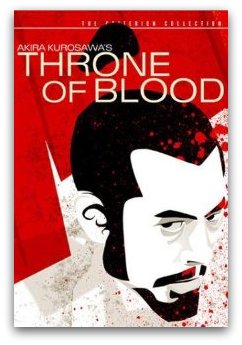
Throne of Blood

Macbeth was the first Shakespeare play I encountered. It captured my imagination more than any other, partly perhaps because it is more concise: it tells a simple tale and wastes no time. I remember at age sixteen that I thought Lady Macbeth was the main influence of the tale, that Macbeth, left to his own devices, would have done nothing.

sword-001

Recently, I watched Throne of Blood, which is Akira Kurosawa’s (1957) filmic take on Macbeth. Though dated in some ways, I found it fascinating, and I thought he placed much more emphasis on the Lady Macbeth figure, Asaji. Because Japanese society was so hierarchical and constricted, particularly for women, it allowed Kurosawa to demonstrate Lady Macbeth’s (Asaji’s) influence. Although women were restricted in Macbeth’s time, it was even more so for Japanese women. Kurosawa created a film that showed subtly and cleverly, how a woman can manipulate a man. Washizu (Macbeth) is not very bright, but he has all the power. Asaji must be very careful how she manipulates him. In this sense I think Kurosawa was limited by the constraints of following the play. Asaji’s collapse is too quick, too brief – she was stronger than that (as was lady Macbeth in the original play).

But enough preamble; this is a bit self-indulgent (and long), but I hope you will bear with me. Without having seen the film, this will mean nothing to you, so all I can do is recommend it very highly. Perhaps if any of you watch it, you can then come back and agree or disagree with me.

 ***

 The film begins…

throneblood-001Throne of Blood – The Review

Myths, Legends and outright Lies

rainbow_overperranI’ve often wondered about the many myths we believe in. There must be thousands, more. I know of only a few, but in many ways modern life is based on myth, what we believe to be true, but which is only partly true or not true at all. You probably wonder what I mean. Well, everybody knows now, for example, that Iraq had no weapons of mass destruction – it was one of the many stories concocted by people determined to go to war with Iraq. I’m not sure, but surely most people know now that WMDs were a myth. Of course there are still those among us who believe the war was justified, and they may well choose to believe the claim. But they believe a myth. It simply isn’t true.

Likewise, when the USA chose to attack Iraq, Americans were told that Saddam Hussein was responsible for the destruction of the twin towers. None of the nineteen people responsible for 9/11 was from Iraq; Iraq had absolutely nothing to do with it, but apparently 60% of Americans believed it to be so. For those who do not want to believe that the war was a mistake, an ongoing mistake that is still costing hundreds of lives, it is much easier to believe that Iraq was responsible, to believe in the myth.

Myths do not need to be quite so important, to have such dire consequences, for example, it is popularly believed that one is never further than six feet from a rat. I’ve no idea where this originated, but the BBC’s More or Less team calculated that there are 3.1 million rats in urban areas; even if they were spread absolutely evenly (which they are not), this would give each rat 5000 square metres, which means that you are never further than 164 feet (minimum) from a rat. But of course, urban myths are a good topic of conversation; it is often more fun to believe them than to coldly consider the truth.

A rather more serious, but archaic myth, is that of King Richard III, who is, or was, widely believed to have murdered the two young princes in the tower. He is the perfect villain, hunchbacked and unappealing, with a record for ruthlessness and murder throughout his very short reign (1483-85). The first time I doubted this was on reading Josephine Tey’s The Daughter of Time, the title taken from the proverb, Truth is the daughter of time, written in 1951, and included in a fictional detective story. It is a forensic debunking of the whole Richard III myth; there is much detail, but basically, most of the evil attributed to Richard was Tudor propaganda, started by Henry VII, his successor, and continued throughout the whole Tudor dynasty, which lasted until the death of Elizabeth in 1603. But, the propaganda was marvellous stuff, Shakespeare’s play was based on it (written in Elizabethan times) and the story became embedded in the public consciousness. I’m sure that many people still believe in Richard’s villainy.

Less seriously again, it is widely believed that Sir Arthur Conan Doyle simply got fed up with writing about his fictional detective and stopped, and that it is only by popular demand that he resurrected him. The truth is more prosaic. In 1903, McClure’s magazine in the United States offered Doyle $5000 ($60000 today) per story; he told them he’d be a fool to refuse, so after a ten year hiatus, Holmes returned. Doyle hated writing the stories; he wanted to write more serious stuff, but continued writing Sherlock Holmes stories for another 25 years, and it is a credit to him that most of them remain of a very high quality.

Apparently, if you ask anyone how many immigrants are in this country (the UK), they will say about a third or 33%, and over half the population (57%) believe that there are too many immigrants. This is the highest figure of many countries surveyed, including the US, Germany, Italy, Spain and France. The UK population that was foreign born represents 11.1%. The unusually high belief that this is otherwise is probably mainly due to the media, papers such as the Daily Mail propagate the myth of immigrants daily, and politicians, especially today’s will soon jump on the bandwagon. Benefit fraud is another popular myth, mainly encouraged by the media. Surveys revealed that people believe that 27% of their money is lost to fraud. In fact the figure is 0.7%, rather a wild difference. These are just two of the many myths that a large percentage of the population live by; their whole belief systems, their philosophies and the way they behave are based on myths.

Lastly, I would like to mention a myth of my own, that of Mother Theresa. In 1992, I was in Bucharest, Romania, during the crisis of abandoned children; I was part of a many faceted and international aid programme that intended to help, and as far as I can see, did help in many ways. I was there for two weeks at the Sisters of Mother Theresa Orphanage in Bucharest. It was a fairly small orphanage, with little room in the building but extensive grounds and playing areas. There were two small rooms where the children, of varied disability, very few were normal, played; there was also a small school room where very basic stuff was taught. The children were allowed into the garden during the day, but only on request from the volunteers (there were about eight of us); the nuns wanted to keep the children inside, where there was little space, because it was easier to control them, perhaps not even control them because they ran wild, but at least they knew where they were.

After a few days Mother Theresa arrived on an inspection visit. She briefly surveyed the premises, not looking at the children once. She ordered that the school be closed ‘God will provide’, so that there would be more room and that the doors to the garden be locked. She did not speak to any of the children or the volunteers. And she was gone. The school remained closed, but we managed to persuade the nuns to allow the children into the garden, as long as we took responsibility for them. The encounter aroused my curiosity and when I got home, I investigated her. It emerged that her sanctuary in Calcutta (now Kolkata) was extremely basic: an iron bed, minimal food and toilet facilities. Nothing else was provided for the children in care under her name. Nothing. Doctors observed a lack of hygiene, unfit conditions, a complete lack of care, inadequate food, and no painkillers. Presumably God would provide.

Over the years I kept an eye on her. Her political contacts included the murderous Duvalier regime in Haiti, Charles Keating of Lincoln Savings and Loans and Donald Trump, in whose private jet she travelled. Of the numerous disasters in India, she offered medallions; no funds were forthcoming from the massive donations she received. In Bhopal in 1984, between 16000 and 30000 people were killed when Union Carbide’s pesticide plant leaked. No compensation has ever been paid and Union Carbide changed its name. Mother Theresa visited Bhopal not long before her death. She walked around while villagers begged her to do something, to spur some kind of action and help them; it was not only a case of people dying, many thousands were injured and since then there have been birth defects. Mother Theresa wandered among the suffering, hands held in prayer, and said merely

‘Forgive, forgive’

she couldn’t wait to be out of there.

Without my Romanian trip, I suppose I would be like anybody else, and believe that Mother Theresa is a saint. Just an example of one of the many myths we live by. Well, in reality, Mother Theresa is not a saint, very far from it. I would go as far as to say she was a very wicked woman.

A Room in Havana

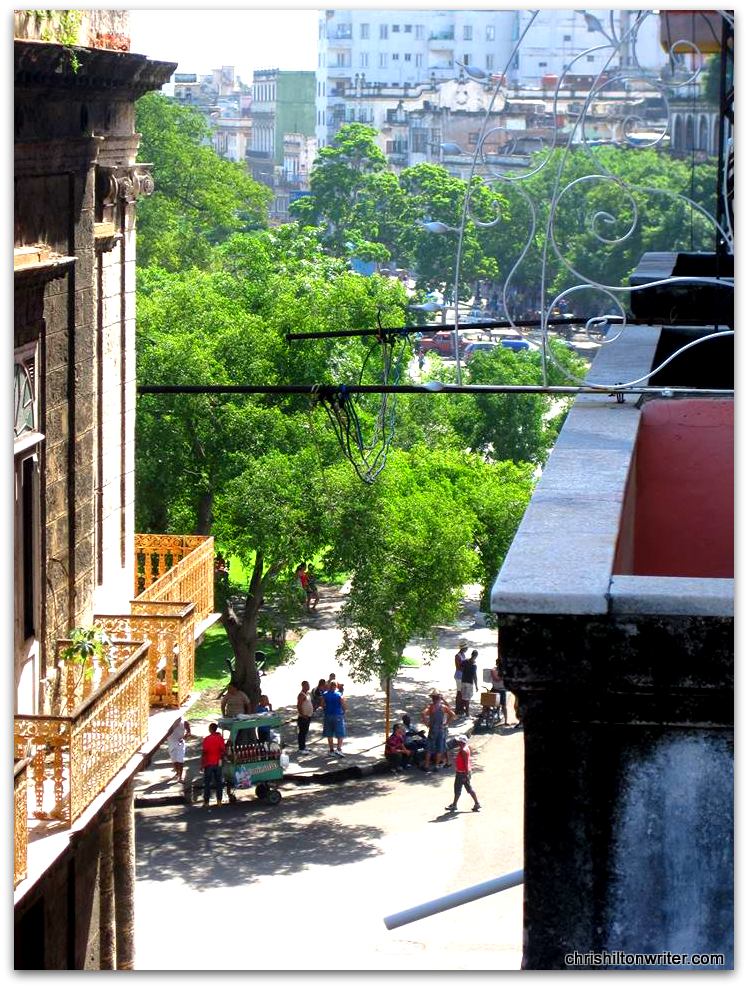
Our flat is on the fourth floor in a busy street in central Havana. It has a living room, kitchen, bedroom and bathroom – quite luxurious for most of Havana, well, luxurious for two people; often at least one family, probably more, would live in a place like this. It has a large balcony, where I spend much of my time, watching the constant action around. My neighbour’s balconies are just a few yards either side of me, and below. We have two

rocking chairs and a metal table with four chairs in the living room, a large bed; the kitchen is small but perfectly usable. We have a TV attached to the wall. Cuba has five stations now; it used to have two when I first visited. Yuri cooks every day.

Cuba13


The people below us were fitting a new bathroom. Intermittently, perhaps three days out of five, there was a constant banging, all day, until six or seven o’clock. It drove me mad. Yuri didn’t even notice it. The banging has changed. Tiles are being reshaped with an automatic grinder. The banging appears to have finished for the time being, cement has been mixed, I can just see it in the moribund bath on the balcony below, and tiles are being fixed. I assume the banging from before was making space for the tiles. There is occasional banging as the tiles are put in place. Everywhere you go in Havana, someone will be banging. Noise is compulsory.

When I first arrived I was completely sensitive to the noise. I insisted we change apartment (although, noise apart, I do like the place we have now). Later, I wouldn’t notice it during the day, but would get irritated if it continued after seven o’clock. Bear in mind that this noise is in conjunction with constant shouting, horns blaring, conversations of neighbours and assorted other noise. Now, after almost two weeks here, I hardly notice any noise. I think the banging would bother me, but it has stopped; the rest: the grinder, the soft banging as the tiles are put in place, the mixing – everything – is ceasing to bother me.

view1

It would be impossible to live in Cuba without acclimatising to the noise. There is something quite relaxing about that. I would not like to be Cuban; I would be at home with the organised chaos that seems to be a part of life here, but I would like to be less bothered by neighbours building a new bathroom, the everyday chaos of life. I would like to be more Cuban, while retaining whatever it is that makes me, me.

I have acclimatised before. I lived here. But I was thirteen years younger. I have certainly changed since then. I still smoke, but hardly ever drink. Before, I could barely go a day without rum. At my worst I would be drinking, perhaps, two bottles a day. I lost myself, had no idea what I was doing. I described the experience fairly accurately in my book, Caliente. I only just recognise the man who had those experiences – what was I doing? – I don’t really know. I came here with a plan. I was naive, some people tried to take advantage, others tried to help, I hardly knew which was which.

At the moment I can’t afford to stay here, although I would like to. My ambition when I get home is to promote my book (something I’ve been unable to do so far), continue with my writing and somehow find a way to live here. It would have to be partly on my terms – I would only intend to be part Cuban.  I would need a library of English books, a large library. I would need access to new books. I have discovered some Cuban and South and Central American writers I like; I’d like to discover more, but there are very few books in English here, and my Spanish is nowhere near good enough for reading. So, I would need a flat (something similar to what I have now would be fine, perhaps a little bigger) and the means to pay for it. And Yuri. That is really all I need.

The people below have started banging again, although it is fairly rare now. I have accepted it. To live in Cuba one must accept the noise, or to be more accurate: to live in Havana. We visited Tony at his Bahia house; it was perfectly quiet. In many ways it would be the perfect place for me. I didn’t like the house when I first moved there with Yamilia in 2001, or later when I lived there through necessity. I stayed there in 2009 with Yuri and I didn’t like it. The main reason for this was that the house is not within walking distance of anywhere: a few shops, a bar is ten minutes walk away, Havana a twenty minute taxi journey – back then it was not enough. But when we visited last week I suddenly realised that now, perhaps, it is ideal. It just what I need.

Before this trip I wondered if I would ever be able to visit Cuba without alcohol, specifically rum. But now I rarely drink. For three years I stopped smoking too, and I could not imagine being in Cuba without cigarettes. During the non-smoking, non-drinking years I didn’t do anything; I never went anywhere. Perhaps I was prolonging my life, but what for, for what reason?  When I began smoking again I came back to Cuba. Not drinking is now easy. I smoke far too much but I am working on that (I’ve been working on it for forty years). So now that I know that I can be here and enjoy myself without rum, Tony’s house becomes rather different. I’d often wondered what I would do with all my books, assuming that I could get them here. Well, Tony’s house is ideal; it has at least two rooms which could be used for books. And it has silence, something I didn’t want before, but now I do seek it like a pain relieving balm – I can become acclimatised to the noise in Havana, but never will I become comfortable with it. So, if I can get my books here, order the occasional new one, write, sell a few books – Tony’s house it is.

redsky2

We went to Yuri’s Padrino’s house. She is undergoing some form of santeria. Some men were banging next door; I was the only person to notice it. Later, much later, when it was time to leave, some men were banging the ceiling at Jose Marti Airport…

Holiday for God

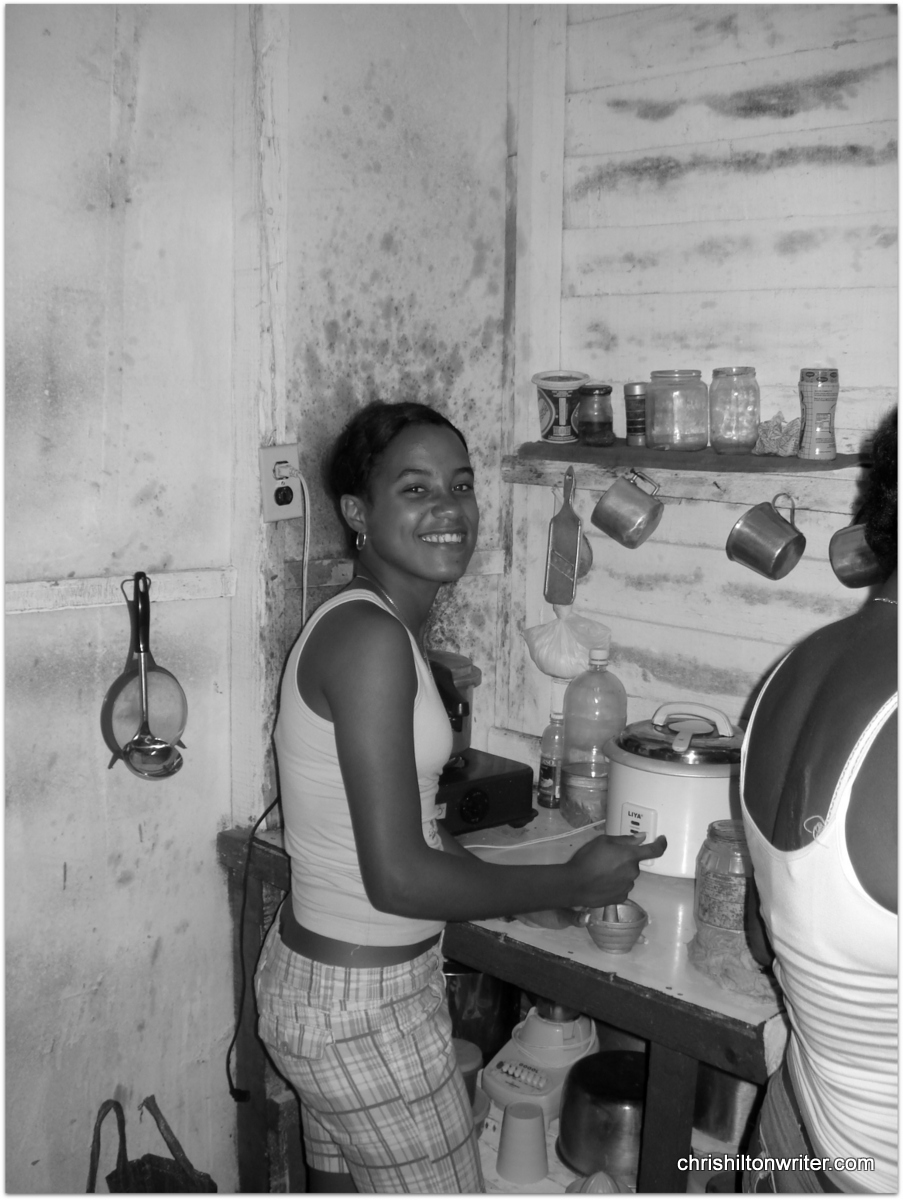
I lived in Cuba from 2000 to 2002, and have visited maybe twenty times since then, sometimes spending three or four months of the year there. I lived most of the time with Yamilia; José was a constant friend, as was his girlfriend Celia. Tony was a business partner; he later became more than that, when I ran out of money, but that is another story. Manolo was a translator, Tony’s acquaintance.

Manolo spoke the best English.  He was word perfect, never slipped up, read books in English, could talk about anything.  I didn’t like him much.  He was bitchy and often depressed, unique in Cuba, and he looked down on people.  He was scornful of Yamilia, the ‘she devil’ and considered her stupid.  Lots of people felt the same way.  They thought she was wasting the opportunities she had by being with me. 

‘Why doesn’t she study something?’

‘Why doesn’t she learn to drive?’

‘Your woman is not clever, she wastes everything.’ 

I disagreed, particularly about the driving.  If Yamilia ever got a license no one was safe.  José had good English.  He was educated, could approach the tourists and communicate.  But, in my time in Cuba, I didn’t notice his English improve.  He often mumbled, repeated the same mistakes.  Tony spoke no English.  Celia spoke well, but never in company.  I had good conversations with her, one to one, but in company she always deferred, she observed rather that took part in life.  That was fine, he didn’t need it.  He was top of his tree.  Why should he learn English?  I couldn’t learn Spanish; I could make myself understood, but with so many English speakers around me, I just didn’t progress beyond a pidgin style, although I did understand more than they thought.

Then there was Yamilia.  Everybody, including Yamilia, considered her English poor, basic pidgin, that’s all.  She’d lived in France for a year, spoke some French and often mixed it up together with her Spanish and English.  She wasn’t sneaky.  Some people thought she understood much more than she let on.  She didn’t.  She did have an uncanny ability to pluck complete English sentences out of the air, though.  Often expressing sly humour, big ideas, home spun wisdom or insults.  Whenever she did speak English she pronounced the words clearly, spoke very well when she strung whole sentences together.  She naturally possessed an imperious, melodic, often mocking tone, and this added to the effect.


Once at Tony’s house, Tony, Manolo, Jose and I had been drinking, talking politics and generally putting the world to rights.  Yamilia had no interest.  She would listen to music, do her nails, hair or just fall asleep on the sofa.  On this occasion she swanned past us on her way to the kitchen singing, at the top of her voice:

‘We are the world, we are the people,’

She sang in such mocking tones that I stopped and watched her.  She gave me a sly smile.  She would have been around ten years old when a bunch of American multi-millionaire egomaniacs got together and made that record, so as not to be outdone by Bob Geldof’s Live Aid extravaganza.  All the sugary, sentimental, self-righteous hypocrisy of that record came across in her mocking tones.  It was the perfect put down of our self-important conversation, and she just plucked it out of the air.  How?  I thought she possessed a natural wisdom and the courage and sense of fun to puncture pomposity wherever she sensed it.  Cubans wouldn’t notice; it was too subtle.  I’m sure it was unconscious on her part.  I sometimes thought Manolo picked up on it, but he was far too against her to give her any credit.  I never even tried to talk about it to her.  She would have had no idea what I was talking about.  It was just there, sometimes, and it amazed me. 


During the longest day we were sitting in Cathedral Square, my favourite place at the time. Very touristy but beautiful and peaceful, no matter what the time of day, no matter if there was music playing, tables full of tourists or just quiet, mostly in the lull between the afternoon trade and the evening pick up when everyone began thinking differently. We would spend hours, sometimes all day there, watching the world go by.  I was in philosophical mood, thinking about the longest day in Cuba, the tropics; not as long as the longest English day, but the longest all the same.  The summer solstice, the day the sun is said to pause.  I liked the idea, something typically Cuban about it, as though the universe paused, took a day off work.  I said as much to Yamilia, explained the summer solstice to her.

            ‘How can the longest day be a holiday for God?’ she said.

She pointed to her head,

 ‘You have problem here.’


Exasperated, she turned away and went back to watching the tourists. I hadn’t mentioned God, or holidays.


YamiliaPicI thought of this story recently. Yamilia is gone. Permanently? I don’t know. I haven’t seen her for four years, although I am in fairly regular contact. She’s in Ecuador. I’m not sure why. And I’m with someone else, Yuri, as different from Yamilia as it’s possible to be. I will be in Cuba for the whole of August. I remember the days with Yamilia with affection but they are in the past; I am sure I will see her again but the three years we were together are a memory now: unforgettable, amazing but gone. During the month I spend in Havana I will write the second part of the memoir started in 1999. It will include Yamilia and bring the story up to, perhaps, 2010. Although I can never repeat the times of 1999 to 2002 (I not sure I’d want to), the next chapter awaits.

………..

Chris is the author of Caliente, a memoir of escape, love and trouble. Lots of trouble.

‘Yamilia waits in Havana. She is astonishingly beautiful and of volatile temperament. Her enemies, and even some of her friends, think she is unstable, even dangerous. José, Hilton’s closest friend in Havana, agrees, ‘She is a bad woman. Do not stay with her,’ he pleads. Hilton disagrees; he’s in love, he doesn’t see her that way – Yamilia is natural, honest, a force of nature. Like a hurricane. He will create a new life with her in Cuba. What could possibly go wrong?’

Too much information

“Distraction is the barrier through which a writer must force his way.”

Saul Bellow

Saul Bellow, in a lecture at Oxford University, said that a typical ‘quality’ newspaper, the London or New York Times, for example, contained considerably more information in one day than even an educated Elizabethan absorbed in an entire lifetime:

“I suspect that an Elizabethan was less confused by what he saw. He would certainly have been less agitated than we are. His knowledge cannot have laid him so close to the threshold of chaos as ours.”

That was in 1990, the Dark Ages in technological terms. How much more information do we absorb today, with the 24 hour bombardment from television, the Internet, Smartphones, iPads, radios and the printed media? More than we are designed to absorb? Can writers rise, clear-headed, above the fray and actually observe their world dispassionately before relating it back coherently to readers and, if they can, will their views be obsolete as quickly as a new phone?

Saul Bellow considered himself above the fray. Although he admitted to a certain daily addiction to ‘the news’, he was more concerned with how to get through to an increasingly distracted audience,

“The concern of tale-tellers and novelists is with human essences neglected and forgotten by a distracted world.”

Surely even Bellow, who died in 2005, would struggle against distraction today.

In 2008 Nicholas Carr wrote an article entitled Is Google Making Us Stupid? Much has been written since on this and related topics, indeed Carr expanded his article into a book, and then another, but I believe this early, brilliant and perceptive article provides most of what we need to know. Carr claimed that the Internet

 “…is chipping away my capacity for concentration and contemplation. My mind now expects to take in information the way the Net distributes it: in a swiftly moving stream of particles. Once I was a scuba diver in the sea of words. Now I zip along the surface like a guy on a Jet Ski. I now have almost totally lost the ability to read and absorb a longish article on the web or in print.”

Carr cites a study of visitors to the British Library research sites, which provided access to journals, e-books and other sources of written information. It was found that people exhibited:

 “…a form of skimming activity, hopping from one source to another and rarely returning to any source they’d already visited. They typically read no more than one or two pages of an article or book before they would bounce out to another site. Sometimes they’d save a long article, but there’s no evidence that they ever went back and actually read it.”

Users would,

“power browse horizontally through titles, contents pages and abstracts going for quick wins. It almost seems that they go online to avoid reading in the traditional sense.”

Rolling news requires that the viewer watch and listen to material that has been repeated hundreds of times already, and is being constantly repeated elsewhere, while also reading about ‘breaking news’ being transmitted in text across the screen, probably with a view of a busy newsroom in the background where newshounds scurry back and forth, dedicated to providing the viewer with news of everything that is happening in the world, as it happens.

Mastering the delights of technology gives the illusion of control. But, for many, is it just an avoidance of life ‘out there’ rather than participation within it? We have the illusion that we are on top of everything, but what, apart from the ability to use gadgets, do we have control of? Since succumbing to a Smartphone I’ve found distraction has increased ten-fold, where once I was available only to calls and texts, now I’m available for everything – always.

Henry James advised writers

“to try to be one of those people on whom nothing is lost.”

Wise and true, I believe, but an Einstein-like big brain is now needed to hold and make some sense of all the information available.

Michael Foley wrote in his excellent The Age of Absurdity (2010) that

“My television and laptop both behave as though they are on first name terms with their owner and have intimate knowledge of his personality and tastes. Nowhere is safe now. I visit my dentist where for, for decades, there has only been dog-eared magazines with missing covers and find a music centre behind the reception desk, a television in the waiting room and a radio playing in the surgery.”

 ***

When Harper (Nellie) Lee and Truman Capote were researching Capote’s In Cold Blood, his ‘factual’ novel about the murder of a wealthy Kansas farmer, his wife and two of their children, they took thousands of pages of notes, interviewing and often befriending residents in their homes. They encountered an unanticipated problem: trying to keep people’s attention away from the TV,

“The nuisance of manic commercials in the background tested Nelle’s and Truman’s patience, especially when the whole point of an interview was to try to talk intimately with someone.”

NBC had recently begun broadcasting from Garden City. It was 1959. Neither Lee nor Capote owned a TV because

“It interferes with work.”

The average American is now subjected to over 3000 advertisements per day. The rest of the world cannot be far behind.

Distraction is nothing new: Virginia Woolf’s dress could be so careless that, according to Quentin Bell, her

“drawers would literally fall down”

and on one occasion,

“everything dropped”

as she was saying goodbye to guests at the door. GK Chesterton once sent a telegram to his wife, saying

“Am in Kettering. Where am I supposed to be?”

Of course their distraction was of a different kind: internal; they had both probably been mentally composing an essay or a novel at the time – this is the internal distraction of the quintessential artist, not the external distraction of modern life.

So how can writers overcome not only today’s distraction of 24 hour information but the noise that accompanies it?

In the 1880s the French poet Jules Laforgue believed that

“the modern world has embarked on a conspiracy to establish that silence does not exist”

and, like Proust, soundproofed his room with cork. Kafka thought that:

“One can never be alone enough when one writes, why there can never be enough silence when one writes, why even night is not night enough.”


NM

“I used to have a little studio in Brooklyn, a couple of blocks from my house – no telephone, not much else. The only thing I ever did there was work. It was perfect. I came in ready to sit at my desk. No television, no way to call out. Didn’t want to be tempted. There’s an old Talmudic belief that you build a fence around an impulse. If that’s not good enough, you build a fence around the fence.”

Wordsworth said that poetry comes from emotion recollected in tranquillity. The tranquillity available to him may have gone forever, but it does not mean that it cannot be found. I find I have to go to expensive extremes to get any serious writing done.  I must have some form of peace to write. I don’t need to be distracted to be diverted from writing. I can do that by myself. If there were an Olympic discipline in prevarication, I’d have a great chance of a medal – although that might be an event with a poor turnout. I planned and wrote by book from home, completed a synopsis and a few chapters and sent them away. When a literary agency told me that they would find me an agent if I could turn my draft into 300 pages of flowing text, I knew there was only one way to do it: get on a plane and go somewhere where I might be able to work without distraction.

bali-001

My Bali writing hole

The first half of Caliente was written in the garden of a cottage in Bali, the second half at a villa in Havana. An expensive and indulgent way to get one’s writing done, I agree, but it wouldn’t have happened otherwise. I can’t blame technological distraction entirely for that, but escaping it was nevertheless a part of the process; in neither place did I log on to the Net apart from morning emails from an Internet café in Bali, and in Havana from hotels with Internet access. I left my phone at home. I don’t regret my decision. I wanted to get the book written and I would have done anything to achieve it.

chriscuba-001My second book will take shape during August, in Havana. It will be extremely hot so I will spend the days in air conditioned isolation while I write for 6 to 8 hours per day, before enjoying a cooler, well-earned night out with friends. To complete the book I will probably need to find peace and isolation again. That peace might need to be found closer to home – a cottage in Wales perhaps – and more frugal writing sites may soon become a necessity. Like Michael Foley, I find much of modern life absurd. I have to escape from it before I can write about it.

“I have lived magnificent days.”

Image

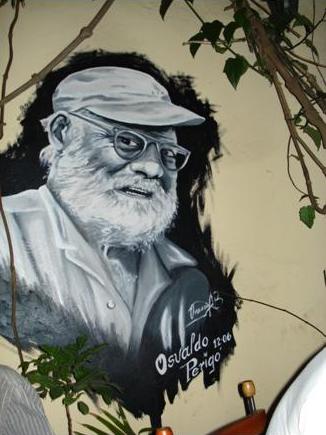
I took the photograph above in 2007 in a restaurant on Obispo, in Old Havana. The restaurant hadn’t been there when I lived in Havana from 2000 to 2002, nor was it on subsequent visits in later years; it had, like many buildings in Havana, been derelict and on the verge of collapse. Practical as ever, the Cubans merely helped the building to fall down, cleared a nice bright space, installed cooking facilities and a bar, put up a canopy for shade and in case of rain, provided music both live and recorded, and it became one of my favourite places.

The mural of Che Guevara was painted by Osvaldo. It was about half complete when I first met him and took a few weeks to finish; he had also painted Ernest Hemingway. His payment for the work seemed to be that he was allowed to take a break every five minutes or so to hustle customers, including me. I was drinking alone one night and happy to buy him mojitos – instant friend.

The image of Che’s face is so ubiquitous that Osvaldo painted from memory; images of Che are everywhere in Cuba – they are also to be found throughout the world, but I’ll get to that later. I asked him if he was a painter. He dismissed the idea; the painting was nothing: he was a musician. Osvaldo was 40 but looked younger; he spoke good English and was impossibly lively, laughing and joking constantly as if he dared not stop. For the price of a few mojitos and the entrance fee to a club or two, I found places and people I otherwise wouldn’t have found. Osvaldo was contemptuous of his subject, Che Guevara, along with Castro, the revolution and the entire Cuban system,

“I am a musician, and what do I get for my talent? Nothing”

he told me, many, many times.

ImageHe was desperate to leave and chased a succession of female tourists in the hope of marrying one. He was just as tireless in this as in everything else: dancing (he was a fantastic dancer), joking, laughing, playing his music (he could play several instruments), singing and generally showing probably hundreds of women a good time. Sadly, when their holidays ended, his reward for this devotion to fun was,

“Thanks for the great time Osvaldo, I’ll never forget you.”

and they left, without him. Osvaldo introduced me to the woman I’m still with today. When I returned later, I asked after Osvaldo

“He’s in Spain”, she said, “He married a tourist.”

I’m pleased for him and hope it’s what he hoped it would be, although I miss him. The restaurant had gone now too; the site remained but it was closed. I don’t know why.*

Ernesto ‘Che’ Guevara would have returned Osvaldo’s contempt, and disapproved of me also. While not humourless, and certainly possessing an unquenchable love of life, he was a very serious man:

“I do not cultivate the same interests as tourists”

he once said, putting me firmly in my place, although I do not think of myself as a ‘tourist’.

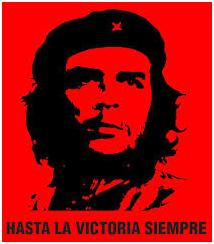
In April 1960, the freighter La Coubre exploded in Havana harbour while unloading munitions, killing at least 75 people and wounding hundreds. Guevara, a doctor, rushed to the scene to treat the wounded. At the memorial for the dead, a deeply affronted crowd were unusually quiet and reflective. Although it has never been proved who exactly was responsible for the explosion, the act was felt personally and viscerally as an attack on the Cuban people, on their efforts to free themselves from years of colonisation. Fidel Castro made a stirring four hour speech (quite brief for him) in which he used the phrase Patria o Muerte for the first time. While attention was focused on Castro, Che appeared briefly and gazed at the crowd for just for a few seconds. Alberto Korda, Castro’s official photographer, took two quick pictures of him before he disappeared again.  It’s probable that Guevara knew of the photograph before he met his death in Bolivia, but, while it hung on Korda’s wall for seven years, few outside of Cuba knew of its existence. Soon after that the whole world knew of it.

cheKorda cropped his original image to show just the face. It hung in his apartment for 7 years.

chepotraitMuch has been written elsewhere about Guevara, the copyright of the most reproduced photograph of all time, and the fortunes made from the reproduction and adaptation of Korda’s work. While Jim Fitzpatrick, who used the image to create his own stylised posters, signed over the copyright of his image to a Cuban hospital,

“because Cuba trains doctors and then sends them around the world.”

Andy Warhol insisted that profits from his own version of the image went only to Andy Warhol; he wasn’t alone. Korda, and his family since, have shown no interest in profiting from the picture. Che’s wife Aleida and his daughter are involved only in trying to limit the image’s misuse.

cheredKorda’s black and white image has been cropped, adapted, stylised, coloured, digitally altered, used, abused and misused for nearly fifty years, but remains essentially the same: an expression of clear eyed determination to fight injustice that has inspired millions. It helps that the subject was charismatic, handsome and enormously attractive to women. Richard Gott, a journalist and writer who travelled to Cuba in 1963 to report on the revolution, met Guevara. In his book Cuba: A New History he wrote:

Guevara strode in at midnight, accompanied by a small number of friends, bodyguards and hangers on. He was impossibly beautiful. Before the era of the obsessive adulation accorded to musicians, he had the unmistakeable aura of a rock star. People stopped what they were doing and just stared. Like Helen of Troy, he had an allure that people would die for.

Unlike many who have been deified after dying young, Guevara was the real thing. He was painfully honest, courageous and completely dedicated. Sickly as a child in Argentina and asthmatic, he nevertheless enjoyed rolling around in the mud, and at the age of fourteen he progressed from mud to an affair with the housemaid. Friends who spied on him described his enthusiastic lovemaking interspersed with blasts from his inhaler, the same inhaler used during the heated battles of his later career as a revolutionary.

His first experiences of poverty came during a 5000 mile road trip through South America, with his friend Alberto Granado, in 1951. Witnessing the crushing poverty of the rural poor set him on a course from which he never wavered. He abandoned his career as a doctor and, via Guatemala and Mexico, joined the Castro brothers Fidel and Raul in the revolution that toppled Batista in Cuba. It may seem naive now, but he wanted to eradicate poverty and create a more just world; people believed in that possibility then. Che was an incurable idealist while Castro was more interested in politics and power, a Fidelista according to Enrique O’Varez, once a student friend of Castro but one of the first who later tried to kill him.

Fidel Castro said of Che that

“he embodies, in its purest and most selfless form, the internationalist spirit that marks the word of today. “

But Che’s unwavering dedication to truth was painful and irritating to many of his colleagues, including Fidel. His rigid honesty spilled over into his personal life when he refused his wife Aleida’s request to go shopping in their official car,

“No Aleida. You know the car belongs to the government, not to me. Take the bus like everyone else.”

Raul Castro said:

“If the day comes when Guevara realises that he did something dishonest in relation to the revolution, he would blow out his brains.”

According to Alex von Tunzelmann, in her book Red Heat, Guevara had,

“always put his principles, however impossible, before the fundamental urge to win, and keep winning. [His] integrity was the problem.”

Integrity and politics do not go hand in hand. Perhaps only half-jokingly, Fidel said to guests at a dinner party,

”I’m going to send him to Santa Domingo and see if Trujillo kills him.”

After a spell in charge of the National Bank of Cuba, where he nearly wrecked the already fragile economy, and disillusioned with realpolitik, he decided to take revolution elsewhere, disastrously to the African Congo and then to Bolivia.  He wrote a farewell letter to the Cuban people and Fidel which included the line:

“If my final hour comes under distant skies, my last thoughts will be for this people and especially for you.”

Castro, while publicly expressing sadness at his departure, must have been glad to see him go.

Later, in Bolivia, he believed that the people would rise up as they had in Cuba, to bring down an oppressive government. Richard Gott wrote that

“He believed with passion that small groups of armed men could defeat established armies, as they had done in Cuba.”

He was wrong. The people were frightened and cowed, too afraid to act; many were willing to betray Guevara and his small band of followers. The end was inevitable. He was isolated with just 24 companions. His death came in a school room at the hands of a Bolivian soldier. Accounts vary, but it is certain that the Bolivians wanted him dead and to make it appear that he had died in battle. They also wanted his face untouched so that they could display him, in death, to the world. It seems certain that he did spit at his executioners and say;

“I know you’ve come to kill me. Shoot. Do it. Shoot me, you coward! You are only going to kill a man!”

A Cuban sniper, Felix Rodriguez, working for the CIA was also present. He claims that he gave the order to shoot Guevara and asked him if wanted to say anything to his family. Guevara replied:

“Tell my wife to remarry and try to be happy.”

In the last letter to his children he wrote:

”Your father has been a man who acted according to his beliefs and certainly has been faithful to his convictions. Until always, little children. I still hope to see you again.

A really big kiss and a hug from Papa.”

chealeidaThere is no doubting his bravery and ability when he had loyal followers, demonstrated when he won a great victory at Santa Clara against all odds. The battle was accurately portrayed in Steven Soderbergh’s epic film, Che. Over 50000 Americans stood, heads bowed, in front of the Lincoln memorial on the news of his death, while ironically it went almost unnoticed in Moscow where disdain was expressed for his adventurism. In the White House, the news was received with satisfaction. Walt Rostow, advisor to President Kennedy, said, “They finally got the son of a bitch. The last of the romantic guerrillas.”

So much has been written about Guevara that would not have been written without the existence of Korda’s photograph. He has become a symbol of revolt, of hope in an increasingly homogenised world, where half the people live dangerous, poverty stricken and fearful lives while most of the other half don’t care or avert their eyes. For a multitude of reasons Cuba’s revolution failed, although it tried, and remains a symbol of hope to many. Cuba can with justification be criticised; Che, through dying young, remains pure; his image portrays the man: his beliefs, his honesty, his courage and his humanity. Whatever happens to Cuba, however history judges Castro (and that argument will never end), that image and its power to inspire will endure. He became worth more dead than alive; not only to Fidel but to radical politics.

That it didn’t inspire Osvaldo is understandable. He wanted a better life. I hope he found it. I’ve seen that image of Che a thousand times and appreciate its power, but I prefer the man behind the legend: the man who set off with his friend to explore South America, who was inspired to action by the poverty he witnessed; the young man determined to have a good time, who fell in and out of love; the man who in battle cared nothing for cleanliness and wagered his compañeros that his shorts would stand up independently if he removed them – they did – and he won his bet; the young man who said after his South American trip,

“I began to realize then that there were things as important as being a famous researcher or as important as making a substantial contribution to medicine: to aid those people”

and never wavered from that promise; the man, who facing death, spat at his executioners and called them cowards. Irritating and unrealistic he may have been, but the image speaks of someone willing to strive for ‘impossible’ principles. Where many revolutionaries have proved to be frauds, fame seekers and sociopaths, Guevara was absolutely genuine.

I told Osvaldo the story of Che’s shorts. He didn’t stop laughing for ten minutes. I think Osvaldo would have liked that young man too, but times have changed. Richard Gott met Guevara just once. Strangely, he was present four years later in the aftermath of his death and, with a Cuban-American CIA agent, Eduardo Gonzalez, was one of only two people present who had seen Che Guevara alive and could identify the body. When Gott asked him where he came from, he replied

“From nowhere.”

Exactly.

“I have lived magnificent days.”

chesig

*   The restaurant has since reopened. It’s still great, but in a different way. Osvaldo’s murals have gone.

Victor Hugo did it Naked

Victor Hugo did it naked, standing at a lectern facing a third floor window of his Guernsey home, overlooking St Peter Port harbour. Tennessee Williams couldn’t stop doing it and worried constantly about it. George Orwell thought it “a horrible, exhausting struggle, like a long bout of some painful illness”, while Evelyn Waugh required “merely silence” to do it; he preferred his children to be “away”. John Lennon thought it ‘torture’ and GK Chesterton believed there was only one way to do it.

penFor many authors, writing is not a pleasurable experience, although Victor Hugo may have discovered a fun element.

Why am I writing about writing? Well, I’ve written one book and I’m desperately trying to write a second. I didn’t begin writing my first until into middle-age and it took me a few years to complete.  I’d always wanted to write, so why did it take me so long?

Because I will do anything rather than sit down and write; tasks I normally hate: cleaning, paying bills, laundry, suddenly take precedence over writing, even though it’s the writing and the ideas for writing that are constantly swirling around in my mind. When I finally force myself to write, the early stages are the hardest, the period when nothing will come, when I believe I’m an utter moron and question my ability: “who are you kidding, thinking you can write?” This is often the stage where I just have to do that extra piece of research, read the latest book on how to write or the latest author biography, switch on that must-see TV programme – or just give up and open a bottle of wine.

But why is writing so hard?

John Yorke, in his recent book Into the Woods, shows that stories follow a pattern, a common structure. This is not a new idea, far from it, but Yorke believes that the archetypal structure matches deep psychological needs within us all: order from chaos, characters changing, confronting their demons to become the people they were always capable of being. This supplies a need for the reader, who is comforted by the process, identifying with the character that brings order from turmoil, confronts and slays the enemy. The detective story is a perfect example: a problem is solved; there is resolution. Most of us do not confront what we fear; we hide and play it safe. This explains the hunger for stories, be they in books, films, soap operas or reality TV shows: secret fears are confronted and overcome.

I have oversimplified outrageously, but I believe that for many writers the process of sitting down and writing is also, like story structure, a confrontation with the enemy: self-knowledge, not only in the sense of revealing oneself but in conquering doubts over one’s ability. In practical terms writing should be easy, you just sit down (or stand naked at a lectern) and do it. But it isn’t easy. Steven Pressfield in The War of Art puts it bluntly:

“How many of us have become drunks and drug addicts, developed tumours and neuroses, succumbed to painkillers, gossip, and compulsive smart-phone use, simply because we don’t do that thing that our hearts, our inner genius, is telling us to? Resistance defeats us.”

I love the idea of writing, I want to write but hide from its practice, unless … unless I force myself to sit and write, probably awful stuff, for at least an hour. Then, miraculously, something happens – not always, it’s not that easy – and the awful stuff begins to make sense: it flows, ideas appear from everywhere, ideas that had been locked away, ideas locked away by me while I resisted and wasted my time, pour onto the page, ideas I didn’t know I’d had; plots change, characters change, and for a blessed few hours I am creating something, something worthwhile and I am enjoying writing. But that initial process of beginning – it’s hard, and I resist it much more often than I embrace it.

The truth is that writing is very hard work; you have to be dedicated and professional to keep going. Norman Mailer put it well:

“One must be able to do a good day’s work on a bad day, and indeed, that is a badge of honor decent professionals are entitled to wear.”

Apparently more than 80% of people say they want to write a book, but less than 1% do. Not all those would-be writers have the ability to write – The X Factor shows us that believing you have talent and actually possessing it are two very different things – but I’m sure there are many talented people among that group telling themselves every day that they will start that novel tomorrow or next week or after they’ve finished researching the history of Florentine art for that Renaissance murder mystery they’ve been planning for five years. Steven Pressfield, straight as ever, gets right to it:

“We don’t just put off our lives today; we put them off till our deathbed.”

And GK Chesterton’s

“one way to do it”

his method of getting it done?

“Apply the seat of the pants to chair and remain there until it’s finished.”

I’m about to do just that, right after I’ve cleaned those windows, they’re filthy.

Havana Book Fair

Despite a lifelong love of books, the Havana Book Fair somehow passed me by during my two year stay. I remember the beautiful Castle Morro as the site of a Saturday night club, where, on a lovely patio overlooking the sea, I sipped mojitos. A sea breeze slapped waves against the rocks and, through the spray, the lights of Havana winked at me from across the bay. The club has gone – bars and clubs appear, disappear and sometimes reappear in Havana – but the castle remains. And so does the Book Fair.

Cubans are generally avaricious readers – I take all the books I can carry each time I return, to give to friends. Books are expensive in the Havana bookstores, beyond the reach of most ordinary people, and the choice is limited. The Book Fair is great event, providing wider choice and the opportunity to find bargains. It is descended upon with infectious enthusiasm by readers of all ages. I’m proud to associate my story with this rich and lovely occasion.

******************

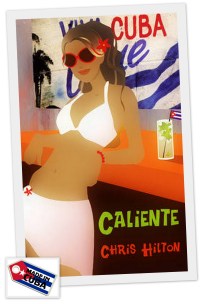
Caliente: a true story of love, adventure, gallons of rum and lots of trouble.

“I must say I was gripped. It has the sweet-and-bitter tang of reality and in my view it will find an eager readership.”

John Carey, Merton Professor of English Literature at the University of Oxford


Caliente CoverExcerpt from chapter one:

I sat in the empty car park and smoked a cigarette.  Then I drove contentedly, dreamily, through the grey, bad-tempered Friday night crawl.  I left my car in the Pink Elephant long-stay car park and booked into the Gatwick Hilton.  I spent the next three hours roaming the airport, drawing dollars and sterling from various ATMs and exchanges.  The next morning I did the same and posted my Pink Elephant ticket to Paul.  The car belonged to him now.  At four that afternoon I boarded a Cubana flight, direct to Havana.  Paul, now free and tagged, called as I sat on the runway,

‘All set Reggie?’
‘All set.’

I had $100 000 in an attaché case and considerably more than that in a Channel Island bank account, accessible in Cuba.  I didn’t set foot in England again for two years.

******************

“Hilton is a delightful guide to the very special atmosphere of Cuba in the last years of the Castro family, and his book should find many readers. I read with immense pleasure.”

Richard Gott, author of Cuba: A New History.

“A fantastic tale, full of pace and steeped in the sense of the place. Hilton really knows Havana.”                                      

Matthew Parris, The London Times

bookfairhavana