How to write…

bin-001.

I’ve always wanted to be a writer, sort of. Apparently my junior school teacher told my mother that my subject would be English. It wasn’t. It wasn’t anything. I was far too busy playing truant, misbehaving and generally having a good time. I took an interest in books in my late teens, but was still far too lazy and preoccupied to get seriously into literature. I loved foreign holidays because I’d take a dozen books with me and read them all. To me that was what holidays were for. At home I was too busy drinking, chasing girls, taking drugs and being bad, to read. I probably read as much during one holiday as I did during a whole year at home. I wanted to read; I bought loads of books – I loved them – I just didn’t read many of them.

.

Times have slowly changed. Now I read a lot, have done for many years, but I still allow myself to be distracted by TV and the Internet. I write a lot too. I have actually written all my life, jotting down ideas, starting short stories, even novels, but never really sustaining anything the way real writers do. Only age has made me slow down and write and I’ve become fairly good at it: one published memoir and a novel just submitted. But it took me forever to do it. The memoir was the result of ten years’ work, on-and-off; the novel has taken me a year, although it was roughly complete in a couple of months.

.

And when you come to write: How do you write? I must have read a hundred books on writing, but I’m not sure I’ve taken one bit of advice. I still sit down and write the way I always do, always have done, with some learning on the way that has been absorbed rather than learned. A sort of osmosis. And that osmosis, the absorption has come about through reading and thinking about what I’ve read, all the time; even in those lazy early days I realise that I was reading and writing and thinking and absorbing, watching people, thinking about it, storing it. And I love books. I love stories.

book-001.

But how do you write? Can it be taught? I think the churning out of stories: vampire stories, love stories, detective stories and all the other variations can be taught, especially in the techno-age. I think real writers are born, not taught: Tolstoy, Balzac, Shakespeare, Steinbeck – they wrote because they couldn’t help it, and they don’t get forgotten. They are with us always. They told great stories.

.

In How I Became a Famous Novelist, Steve Hely wrote:

.

But as I walked out through the shelves, I looked at the work of my colleagues. There was Hemingway – A Farewell to Arms, For Whom the Bell Tolls – all those pseudo-epic titles with women dying in the rain, bullfights, and Italian vistas. He knew the deal. He knew doomed Mediterranean romances would pay for Key West beach view and a new fishing boat. And Fitzgerald, who’d tricked the eye with an Ivy League pedigree and convinced the world that a rich guy who threw parties was some kind of metaphor. There was Faulkner, a southern huckster in the Bill Clinton mould, who suckered you in with his honey voice and tales of landscapes soaked in tragedy.

.

Is this true? The great novelist as con-artist? It made me think. I like Hemingway’s short stories. I loved The Old Man and the Sea when I was very young, but found it mostly awful when I returned to it recently. I didn’t like a Farewell to Arms; it read like the script to a very bad ‘B’ movie. I liked The Great Gatsby, but not that much. It’s OK, but I’ve never understood its reputation. I’ve never read Faulkner. Con-artists? Hely continues:

.

It went on back to Homer, who’d written stories so ridiculous, so full of special effects and monsters and busty, half-divine sluts that Hollywood would be ashamed to make them. And he’d pulled it off! He’s punched it up with rosy -fingered dawn and the sickeningly cloying scene of Prium begging for his son’s body. That blind old trickster probably got more chicks (or dudes) than Pericles.

.

On through Dickens, with his pleading orphans and sweetheart aunts; Mark Twain, with his little cherub-faced rascals and mock rural slang; James Joyce with his whisky-soaked-stage-Irish blarney – they were all con-artists. They weren’t any better than the guys who write beer commercials or sell car insurance over the phone. They just had a different angle.

.

Now, Dely is writing tongue-in-cheek here (I hope), but is there any truth in what he says? I’ve read very little Homer (I find it difficult), but I like Dickens and Mark Twain a lot. James Joyce’s early stories were great but then he lost me – I’ve tried Ulysses several times and it always defeats me. But no better than the guys who write commercials?

.

Norman Mailer wrote that

‘It’s as hard to learn to write as to play the piano’.

It is. Even for the jobbing writer who turns out average stuff. Sitting down in front of a blank page is a real challenge, it can be daunting, and it was just as hard for Joyce and Hemingway. Being a writer is not easy. Take this from someone who invents fresh avoidance tactics every day. I would do anything to avoid writing. Con-artists? I don’t think so. Lucky, in a few cases, maybe, shysters, no.

But back to how to write. For all the books I’ve read on writing, I think I’ve only picked up a few rules, and I probably knew them anyway. One of them is Elmore Leonard’s favourite rule: Do not use adverbs: ‘said’ with the name of the speaker at the end of a piece of dialogue is enough, and only occasionally to identify the speaker. If I pick up a book in a shop and read ‘John said hopefully’ or ‘sadly’ or ‘doubtfully’ or whatever, I put the book straight back on the shelf. The reader does not need to be told. They can and want to figure it out for themselves. If the writing is good enough the reader will know how the words are spoken or they will work out their own version. Don’t tell them.

.

Don’t tell the reader how your characters are feeling.

.

Chekhov this time:

.

Shun all descriptions of the characters’ spiritual state. You must try to have that state emerge from their actions. The artist must be only an impartial witness of his characters and what they said, not their judge.

.

Let your readers judge character and feeling. Let them do the work. That’s half the pleasure of reading. I remember when I wrote my memoir, describing a policeman (who had caused me a lot of trouble) skidding away from a police station on his motorbike, leaving me standing in a cloud of dust. A woman who later read the account said she liked the description. Why? Because you didn’t say how it made you feel.

.

Sis Field writes screenplays but his advice applies to any writer of fiction:

.

Without conflict there no drama. Without need there is no character. Without character there is no action. Action is character. What a person does is what he is, not what he says.

.

Action is not necessarily people fighting or shooting or special effects. It can be a knowing smile or the way someone smokes a cigarette. Elia Kazan, someone else who worked with the screen, said

.

‘It’s twenty times better if violence is suggested rather than if you’re explicit. What you imagine is much more frightening than what is seen.’

.

The same applies to writing novels. Take your reader into another world, tell them a story, but let them imagine the most important aspects of it.

Those are the only things I’ve picked up on from all those books on writing, and I think I knew them already. I absorbed what made good writing from the hundreds of good books I’ve read. And of course you need a modicum of talent. And the most important rule of all?

Work hard. Really hard. The aspect that I find the most difficult.

As G.K. Chesterton said, there is only one way:

Apply the seat of the pants to the chair and don’t get up until it’s finished.

.

chriscuba-001

Writing Heroes – Ernest Hemingway

Ernest-Hemingway1

I have a strange relationship with Ernest Hemingway. I read The Old Man and the Sea when I was very young, and loved it. I was completely caught up in the story of the Cuban fisherman who caught a giant marlin while way out to sea and…well I won’t spoil the story for those who may want to read it. Then I didn’t read anything else by Hemingway for 30 years, picking him up again when I first visited Cuba.

.

Probably as much has been written about Hemingway as any other writer. As with many writers, even Nobel prize winners, the critics at first loved him, perhaps over praised him, and then turned against him, sometimes with justification. But the critics turn against almost everyone eventually and: Who are they but people who can’t write, people who can’t tell stories?

.

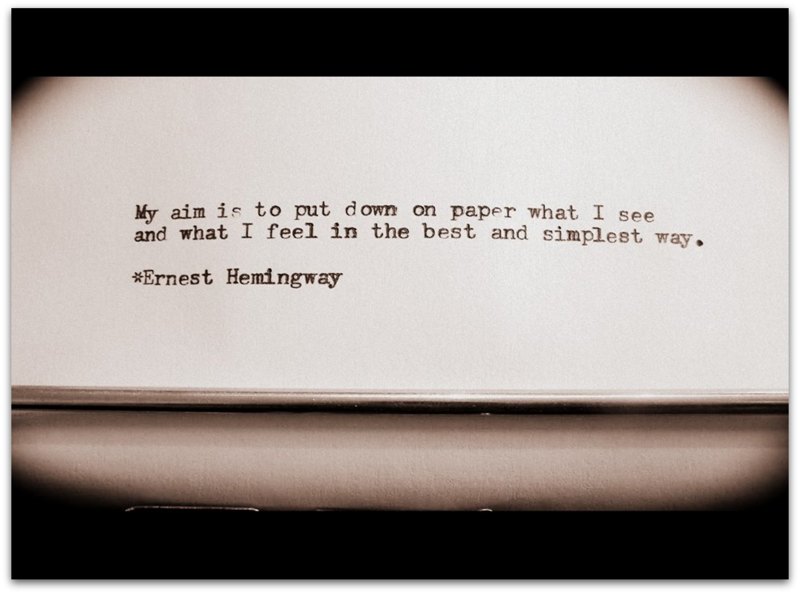
I haven’t even read all his books, but he did change the way many people write, so he’s endlessly interesting, his incredible life apart. When I returned to Hemingway I read his short stories and turned first to Big Two Hearted River, which I’d heard was special. It was. By this time I thought much more about writing; I couldn’t be pulled along by a narrative as I had been by the Old Man and the Sea, and had not been much impressed by any new writing. The story hit home. I understood Hemingway and what he did and what he meant to people. When Samuel Putnam asked Hemingway what his aims were in the twenties, his answer was:

Put down what I see and what I feel in the best and simplest way I can tell it.

.

Well, he did that in 1925 with Big Two Hearted River. I found some of the writing moved me (a rare experience); it sounds corny but reading it was like being there. You felt it. I don’t know if it will have the same effect here, in isolation, but here goes. Nick has just set up camp, alone, by the river:

.

It smelled pleasantly of canvas. Already there was something mysterious and homelike. Nick was happy as he crawled inside the tent. He had not been unhappy all day. This was different though. Now things were done. There had been this to do. Now it was done. It had been a hard trip. He was very tired. That was done. He had made his camp. He was settled. Nothing could touch him. It was a good place to camp. He was there, in a good place. He was in his home where he had made it. Now he was hungry.

.

This passage reminded me immediately of my hitch hiking days in Europe. After a day on the road, find a site, pitch your tent and you were done for the day. But it didn’t just remind me – it made me feel it. Hemingway has captured that sense of achievement, of creating your home, being comfortable and being all set for the evening, perfectly. It is a wonderful, simple piece of writing. It looks easy – anybody could write that – but they couldn’t. I liked most of the other short stories too.

.

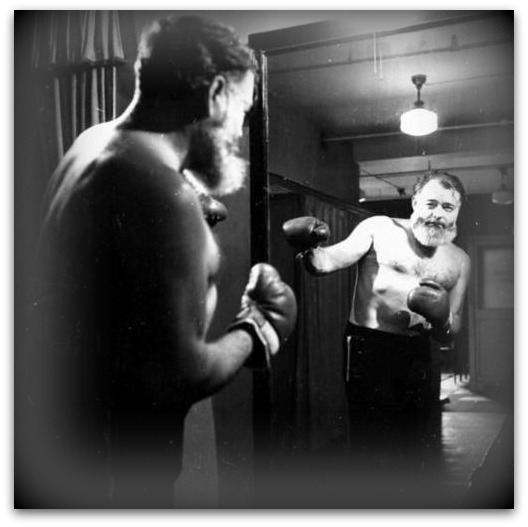
I also read Hemingway’s first novel, The Sun Also Rises. I enjoyed it but not so much. Already his macho tendencies were creeping in. Later I disliked A Farewell to Arms. It seemed to me thoroughly sentimental, not really an experience of war but a man imagining the part he would like to play in it. Hemingway was intensely competitive: the great white hunter, the fearless war correspondent, the champion fisherman, the boxer, the drinker. I felt it tainted most of his writing after the short stories.

Ernest-Hemingway

I liked For Whom the Bell Tolls and Across the River and Into the Trees; I didn’t like Islands in the Stream. A Moveable Feast is an entertaining, but not entirely true account of Hemingway’s early days in Paris. The Garden of Eden is very strange, an erotic ménage a trois, again based on his early days in France. But with success came obsessions: to hunt, to own a boat and catch the biggest fish, to be present, though not necessarily involved in, war. Ultimately it felt that Hemingway was in constant competition with everybody, even poor Scott Fitzgerald, whose fragile psyche he messed with.

.

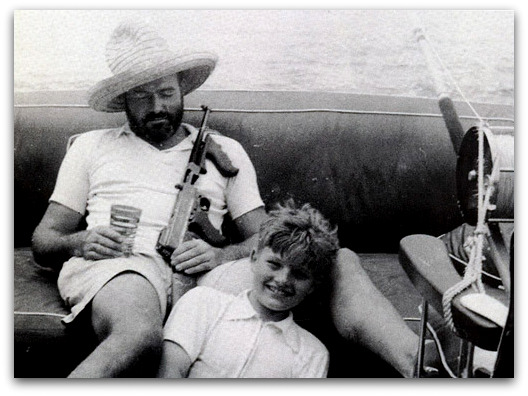
The story that did for me occurred long after he had lost a lot of friends because of his behaviour. He was on his boat, Pilar, in Cuban waters with a good and old friend, Mike Strater. Strater had hooked a really big fish, the biggest he’d ever caught and bigger than anything Hemingway had ever caught. He was slowly reeling it in to the boat. It was being followed by sharks but they only really go for blood; he would have got it on board. Hemingway grabbed his machine gun (he loved shooting sharks) and sprayed the water. Strater’s fish was attacked. By the time they landed it the bottom half had been eaten away. It weighed in at 500 pounds, but would have weighed double that whole. It was pure jealousy, stopping a friend from beating him. He then lied about the event in an article for Esquire. Friends don’t do that.

.

Of course his whole life was tragic. There were five suicides in his family. It is thought his father had the genetic disease hemochromatosis, where the inability to metabolize iron culminates in mental and physical deterioration. Hemingway’s hemochromatosis had been diagnosed in early 1961. Hemingway’s father, siblings Ursula and Leicester and granddaughter Margaux all died by their own hand. Hemingway’s youngest son, Gregory, died in 2001 as a transsexual named Gloria. Several books could be written on Hemingway’s life, but here I’m just concentrating on the writing.

1378005_220774171380172_642680628_n.

I returned to The Old Man and the Sea a few years back and didn’t like it much. Was that just the result of me becoming older and more cynical? Partly, but not wholly. Although it showed flashes of the old Hemingway, I thought it was overly sentimental and contrived.

In Hemingway’s Boat: Everything He Loved in Life, and Lost (2012), Paul Hendrickson spends over 700 pages trying to rescue Hemingway’s reputation. I don’t think he does it. In many ways he was an awful man. His writing remains though, and many of his early observations have stayed with me. Carlos Baker:

Hemingway always wrote slowly and revised carefully, cutting, eliding, substituting, experimenting with syntax to see what a sentence could most economically carry, and then throwing out all the words that could be spared.

.

The actual, he wrote in 1949, is ‘made of knowledge, experience, wine, bread, oil, salt, vinegar, bed, early mornings, nights, days, the sea, men, women, dogs, beloved motor cars, bicycles, hills and valleys, the appearance and disappearance of trains on straight and curved tracks…cock grouse drumming on a basswood log, the smell of sweetgrass and fresh-smoked leather and Sicily.’

.

Perhaps not so awful.

chriscuba-001

Still Reading in Bed…

IMG_0369

Below are two paragraphs from my December blog, Reading in Bed. I return, reluctantly, to it now.

Julian Barnes’ Booker winning novel is a beautiful object; I read it over a few nights, entirely from a prone, on my back, position. And it is not a practical object. For a very simple and infuriating reason: its inner margins are too narrow. The book requires an uncomfortable and impractical two hands to be able to see the whole of the text; in other words, without forcing the book wide open with two hands the inner text on both pages will disappear into the fold of the book; one is constantly tilting the book this way and that to read the end of the sentences on the left-hand page and their beginning on the right hand page. This is unusual with hardback books, but this is a small book.

.

Although this fault is most noticeable in bed – I suppose publishers will protest that books are not designed to be read in bed (if not, they should be) – it is almost as annoying when reading anywhere in any way. If, like me, you love books as ‘physical’ objects then you will resent having to practically break their backs to read the central text. Apart from the discomfort and the detraction of pleasure, you are damaging the book, shortening its life – the act of doing this, bending the two halves of a paperback hard against its spine makes me angry; apart from the inconvenience which has been added to what should be a pleasure (depending on the book), I resent having to treat a book this way. It should never be necessary.

.

When I wrote that I had also intended to include a survey of the books I owned: note the good ones and the bad ones, unmask the guilty publishers and provide some kind of guide. It proved too time-consuming and difficult and there was no consistency. The same publishers would provide both the readable and the unreadable. I was slightly disappointed that there was no pattern, nothing to complain about (except generally) to anyone.

.

.

However I’ve recently bought two books that confirm absolutely the faults that I mention. So I’ll report on them. Perhaps others could do the same. Maybe a pattern will emerge.

.

A while ago I purchased Far From The Tree from Amazon. Written by Andrew Solomon, it is about parents, children and the search for identity. The reviews were spectacular, far too many good reviews for them to have been an old-pals-act. It’s the sort of book I cannot resist, particularly as I believe there are very few decent books being published, or at least widely publicised.

.

But when it arrived from Amazon, I first thought of returning it, then slotted it into my shelves, probably never to be read. It will be in a charity shop within the year. Why? 958 pages have been crammed into a too small paperback. The book measures 8.5” x 5.3” x 2” (215 x 135 x 50); its type is fairly small, but not quite too small with fairly narrow line spacing. But that is not the main problem. The problem is the inner margins and flexibility. The inner margins are never wider than a half inch and the book is not flexible enough to open flat, making it difficult at any time to view a whole page in comfort. In my view it would be impossible to read in bed; I won’t even try. As much type as possible has been squeezed into the smallest possible space. The book is published by Vintage; it is printed by Clays Ltd of St Ives, although I assume printers just follow instructions. I consider the book a useless object: Price – £11.99.

.

Now, I know putting 958 pages into a readable paperback represents a challenge. I checked some of my books for a comparison. Edward Gibbon’s Decline and Fall of the Roman Empire has 1114 pages. It is printed in a slightly smaller paperback and has smaller type. But it is flexible. The book opens flat at any point and is easy to read, in bed or otherwise. It was published in 2005 by Penguin Classics.

.

An alternative is simply to print a larger paperback. Proust’s Remembrance of Things Past, Volume 1 and 2, have 1360 pages and 1288 respectively. Wordsworth Editions (God praise them) have simply published the book at 9 x 6 x 2.25 (230 x 150 x 55). It is flexible at all points and has large inner and outer margins. Heavy to read in bed, perhaps, but no fault of the publisher. Incredibly, it is available, new, at £6.99 (£5.24 from Amazon). I think Wordsworth always produce readable volumes. If I’m wrong, please let me know.

.

Just to prove inconsistency, I’ve just checked my version of Anna Karenina. It’s also published by Penguin (2001). It has narrow, inconsistently sized inner margins and is not flexible. To me it’s unreadable. Off to the charity shop with it. The Wordsworth edition is £1.99, I’ll buy that one.

.

082

.

The other book I bought (today) was purchased in Waterstones: Constellation of Genius: 1922: Modernism and all that Jazz, by Kevin Jackson. I looked through it and it seemed fine. On getting it home for a closer look it is not so good. It consists of diary type entries for the year 1922. The diary entries are set towards the middle of the page. That’s OK. But the inner margins are inconsistent, barely a quarter of an inch in places, making the entries hard to read. The book is fairly flexible and quite nicely produced, but why this inconsistency? On pages 250 and 251, for example, the type almost merges at the centre of the page. All through the book there are massive outer margins, just wasted space; I wouldn’t care at all if outer margins were narrow. Most of the book is fine (just), but tiny inner margins for no reason – it seems so careless The book is published by Windmill Books, part of The Random House group, at £9.99.

.

According to the Amazon reviews the book may be badly or nonexistently edited too. That’s something I’ll return to another time. It seems that many publishers are only interested in rushing books out as quickly as possible, with little thought for quality.

That’s it. Rant over. Please let me know of other cases of thoughtless printing (and good printing too). I don’t suppose we can do anything about it, but we can try.

chriscuba-001

Somebody Say Something

Graham Greene wrote that:

=

The writer’s duty is to make trouble for any dominant power, forcing complacent authorities and submissive followers to confront difficult questions.’ They should be ‘grit in the state machinery.’ He says that disloyalty is essential against anything that is ‘part of the establishment – churches, universities, businesses, social and cultural groups, even great literary figures such as Shakespeare. If any of these institutions or people are deserving, they can survive the criticism directed at them. Otherwise, no one will suffer unduly except the pretentious, the humourless, the dogmatic, the corrupt.’

There is nothing contentious in this statement, it is just common sense. Any power should be able to tolerate and absorb criticism. Criticism is necessary for democracy, or at least a healthy society, to thrive. Yet I see very little criticism of authority today. Of course it is there, perhaps more than ever, but it is mostly hidden, confined to the Internet or minority, specialist outlets. In the mainstream there is little of any relevance.

V.S. Pritchett described Greene as ‘genially subversive’ and suggested an appropriate maxim for him and those like him:

The world is too complacent. Let us catch it out.’

Greene was a very good writer and an extraordinarily interesting man. There were many like him: George Orwell, John Steinbeck and, later, Norman Mailer to name just a few. Orwell wrote of Charles Dickens that he was:

Generously angry…a free intelligence, a type hated with equal hatred by all the smelly little orthodoxies which are now contending for our souls.’

.

Orwell wrote that in 1939 about a man who wrote in the previous century. What would he think of the standard of writing today? Who confronts our ‘smelly little orthodoxies?

.-

Orwell also wrote about ‘the emotional shallowness of people who live in a world of ideas and have little contact with physical reality.’  That describes almost everyone in authority in the Western world today, particularly where I live in England – public schoolboys and girls are everywhere, completely out-of-touch with reality, living in a strange cocooned world of privilege, but nevertheless possessed of a disturbing certainty that what they are doing is right, that there is no other way. It is much the same with TV, journalism, in fact the media as a whole.

Far too many people are only interested in trivia. Twitter, Facebook, computer games and porn are all escapes from reality, time spent on them provides an excuse not to think. Authority conspires in this, often unthinkingly, until we are all engulfed in nonsense. Meanwhile a significant minority goes on its merry way, leading the world to disaster. Here is not the place to discuss what that disaster or disasters may be, I am merely addressing the reporting of it, the writing about it, particularly in books, newspapers and magazines. Many people believe that print is a thing of the past. I don’t agree. Generally, most people do not absorb or remember what they see on their screens; they don’t really learn anything – it is just an escape from thinking.

So, who in print is addressing real problems? Where are the influential writers of today? Who is publishing them? Where can I buy their books or read their articles? I hope I’m wrong, but I know of very few, especially novelists. Is there anybody out there who isn’t just playing the game, just lining their own nest?

q765-01

Norman Mailer wrote of the American WASP that:

They were not here on earth to enjoy or even perhaps to love very much, they were here to serve, and serve they did in public functions and public charities (while recipients of their charity might vomit in rage and laugh in scorn).’

.

Mailer wrote that in the sixties; he was still genially subversive in 2006, not long before his death at 85:

.

‘Global capitalism does not speak of a free market but of a controlled globe. It is alien to the creative possibilities that have not yet been tapped in legions of people who’ve never had a chance to be creative, who work and die without creative moments in their lives. Their hopes have been buried. When talented people emerge from no apparent cultural background, I see them as the product of ten generations of frustrated people who wanted more than their lives gave them.’

Some fine writers have died recently, Norman Mailer, Gore Vidal and Christopher Hitchens among them. Far from perfect human beings, but thinkers, writers, troublemakers – they always had interesting things to say. I find it hard to think of anybody now who is challenging today’s awful orthodoxies. Is there anyone?

Britain produces an extraordinary amount of commentary, in print, on television and on radio: so much that the production of opinion seems to be our dominant industry, the thing we are best at and most enjoy doing. Most of it isn’t bad commentary. If the broadsheets were badly written, if the sermonisers and pundits couldn’t speak in coherent sentences, if you routinely tuned in to hear people not making any sense, it would be much easier to dismiss. That though is not the problem with what passes for discussion in Britain. The problem isn’t that it’s low-grade: It is mostly fluent, clear, coherent and often vividly expressed. The problem is that it is almost entirely free of fresh ideas.

You can go whole weeks without encountering a new idea; you can listen to hundreds of hours of media debate and encounter nothing new. The void is at its worst when there is a conspicuous attempt to fill it: the frowning politician pretending to think, as he mimes sincerity; the pouting celebrities spouting forth on the issues of the day, when their only motive is to draw attention to themselves. You witness these performances (and that is what they are – acting) and you think: I wish somebody would say something. Because this is the feeling I get about British life, a bizarre feeling given how much talk there is, but one which goes very deep: you get the feeling that nobody ever says anything. You watch the television, read the newspaper, and wait for somebody to say something…and wait…and wait…and wait…

John Lanchester wrote the above in the London Review of Books. He wrote it TEN years ago. We are so, so much worse off now.

chriscuba-001

Smoking

At the beginning of the film Smoke (1994), one of my favourite films, William Hurt mentions that Walter Raleigh was a favourite at the Court of Queen Elisabeth I and that smoking (Raleigh had discovered tobacco) had caught on at the court. He said that Raleigh once made a bet with Elizabeth that he could measure the weight of smoke. Toldwalterraleigh it was impossible, like weighing someone’s soul, he took an unsmoked cigar and weighed it on a balance before lighting up and smoking it. He carefully tipped the ashes into the balance pan. When he was finished he put the butt alongside the ashes and weighed what was there. Then he subtracted that weight from the original weight of the unsmoked cigar. The difference was the weight of the smoke.

*

Later in the same film Hurt tells Rashid the story of Bakhtin, caught in the Siege of Leningrad in 1942. He’s holed up in an apartment expecting to die any day. He has plenty of tobacco but no paper. Desperate, he took the pages of a manuscript he had been working on for ten years. He tore up his manuscript and rolled cigarettes from the pieces. Rashid asked if it was his only copy. Hurt says that it was and ‘You think you’re gonna die, what do you want? A good book or a good smoke?’ So he huffed and he puffed and little by little he smoked his book.

*

I quit smoking in December. I’m really depressed about it. I love smoking, I love fire, I miss lighting cigarettes. I like the whole thing about it, to me it turns into the artist’s life, and now people like Bloomberg have made animals out of smokers, and they think that if they stop smoking everyone will live forever.

David Lynch

*

I recently started smoking again after 3 years, the longest period I’ve managed to stop. I wasn’t even missing smoking at all, had got past all the withdrawal symptoms and thought of myself as a non-smoker for the rest of my life. A drink with an old friend, a cigarette, convincing myself I’d only have a couple and I was hooked again. Not only hooked but now I don’t want to stop; it’s too late – I enjoy smoking. If you’ve never been a smoker then I suppose it’s hard to understand, but the response of Bakhtin was the action of an addict – I am an addict. I started through boredom with my job at seventeen and now I’m stuck with it.

*

He found a tree that had not been damaged by shellfire and sat down beneath it, lighting a cigarette and sucking in the smoke. Before the war he had never touched tobacco; now it was his greatest comfort.

Sebastian Faulks – Birdsong (1993)

smoke*

Although I am a smoker I never, when I had given up, looked down on those who smoked. I did reach a stage where I felt sorry for them, thought of the health damage and the expense, but I would never object to anybody smoking anywhere, even in my own house. In years to come we will probably look back and consider smoking insane, but for now it persists. I accept that people should not be subjected to other people’s smoke in restaurants and pubs, but to ban it everywhere is ridiculous; there should be smoker’s pubs and smoking rooms in non-smoking areas. The Health Police have gone too far.

*

Whatever Aristotle and all the philosophers may say, there is nothing equal to tobacco. All good fellows like it, and he who lives without tobacco does not deserve to live.

Moliére

*

Smoking is supposed to aid writing; it certainly feels as though it does. I smoke loads as I write. When I didn’t smoke I continued to write. I look back and find stuff I wrote then and some of it is rather good. It just didn’t feel as though it was good. I am undecided. While I was a non-smoker I became a recluse; I didn’t go out and I didn’t travel because the temptation to smoke would have been too great. I think I have just been smoking for too long to stop. Who knows what I would have written if I hadn’t started. But I did.

*

Dear Mr Eliot

I read in the current Time Magazine that you are ill. I just want you to know that I am rooting for your quick recovery. First because of your contribution to literature and, then, the fact that under the most trying conditions you never stopped smoking cigars.

Hurry up and get well.

Regards,

Groucho Marx

*

It’s very hard to explain to non-smokers why you smoke. You smoke because you’re addicted and you enjoy being addicted. Look at any film before the eighties and everybody is smoking. The tobacco companies held sway then; they had convinced enough people that it did not damage your health and we wanted to believe them. There wasn’t a big movement against smoking then; too many people did it. Now the anti-smoking brigade hold sway; it’s mainly poor people that smoke, and the citizens of poorer countries where the tobacco companies can still influence young people. I suppose it’s crazy, a really stupid thing to do, but it has its attractions. The writer Iain Banks died last year. He was diagnosed with terminal gall bladder cancer and died very soon afterwards at the age of 59. I had enjoyed some of his books many years ago and remembered a passage from Complicity (1993).

*

We tried another cigarette, and by then I’d – maybe instinctively – sussed how to handle it. I sucked that smoke in and made it part of me, joined mystically with the universe right at that point, said Yes to drugs forever just by the unique hit I got. It was a revelation, an epiphany… this was better than religion…I became a semi-junkie that day, that afternoon, that hour. It was that virginal rush of toxins to the brain…truth and revelation. What really works.

*

Although the above is taken from a novel, I’ve no doubt those were Banks’ thoughts too. He met his sudden death with equanimity. I do not know how much he regretted it, how much longer he would have liked to live. Longer I’m sure. I remember a cartoon I saw somewhere: two decrepit old men sit in an old people’s home in wheelchairs.

.

‘Just think’

*

says one to the other

*

‘if we hadn’t looked after ourselves we would have missed all this.’

*

Of course that leaves out the often terrible deaths suffered by smokers. We all think it won’t happen to us.

*

Although I don’t think I’ll attempt to give up again, I’d like to try electric cigarettes. I’ve bought some but haven’t got round to trying them yet in case they don’t work. The Health Police are banning the advertising of them and are trying to ban the cigarettes too; their reasoning being that they fear people will try them and then take up smoking, when it’s obvious that the opposite is happening – people are using them to try to stop smoking. I’m encouraged that a serial smoker like Martin Amis is using them. If they work for him…well, I’ll try them soon.

*

On the wall was a sign bearing the saddest words Keith had ever read.

NO SMOKING.

Martin Amis – London Fields (1989)

*

chriscuba-001

Leaving…


Leaving is the story of two girls, Natalie and Bonnie, who leave home at more or less the same time. They are fifteen and from very different backgrounds. Too young to leave home (officially), they have both had enough of their respective home lives.

Natalie is highly intelligent, has no obvious reason to leave but senses there is something that she wants outside of her present existence. She is highly intelligent but also impulsive, in ways she doesn’t yet understand. Bonnie has hardly formed a personality. Circumstances force her away from home. She has only a determination to endure and knows little about herself – apart from the fact that she is a survivor.


IMG_2140“The story had probably been percolating within me for a long time when it suddenly came to me whole. I wrote the complete first draft in three months. I was interested in two girls who didn’t like the world they were in and decided to do something about it. They reject the surrounding world completely and create their own.

I will send the novel to my agent and various other outlets shortly. Here are the first few chapters . I am doing this, of course, to see if people like the story. I am very confident though, that it’s a good tale. I hope you like it.”


Lard Boy sat eating and hitting keys on his computer. He rarely moved, except to reach for a cake and stuff it whole into his mouth. Perhaps he would swivel his chair from his iPad, to his Xbox, to his computer, to his TV, and sometime, who knew what time, he would fall into bed. He rarely spoke, just grunted, demanded food or, if nobody was around to serve him, he would raid the fridge. His fat buttocks hung over the edge of his stool. His lanky, greasy hair hung unevenly – mummy cut it, badly – otherwise he just wouldn’t bother. Natalie wondered if he had ever spoken to her; really spoken to her. He’d grunted, swore, repeated inane witticisms from the TV and the Internet, but never actually said anything. He’d never really spoken at all. He was thirteen years old and he’d never said anything; never had a thought about anything either. He was just a lump of lard.

She watched him from the door. He was quite unaware of her. She tried to summon up affectionate feelings for him, but they wouldn’t come. His bedroom was twice the size of hers with a mass of equipment; OK, she didn’t want all the gear that he had, but if she did, she’d have needed to ask for it. He was given everything, mummy’s boy. Would she miss him? Not for a second. He was going with his mother tomorrow. Her mother! Although she much preferred not to believe that – somewhere there had been a mistake, a terrible mistake. Somehow she’d been transplanted into this useless family – somewhere, there had been a terrible mistake.

Tomorrow, mother would take him to Greece, some island, where miraculously their fat would disappear. Fat mother would ‘find herself’ and Lard Boy would return wiry, toned and dynamic. They would go together because he needed constant supervision; he couldn’t take a dump without supervision. She said goodbye; he ignored her. She shouted another goodbye – he’d be leaving early – and he grunted. She knew that was it. She moved along the corridor to her mother’s room, knocked and put her head round the door. ‘Have fun in Greece,’ she said, a stupid cliché but nothing else would be understood. Her mother looked up briefly from her magazine, said ‘Thanks, darling’, and went back to her furniture or fashion or celebrities. Would she miss her mother? Not for a second.

She was fifteen, but she thought she could make herself look eighteen. She’d miss her piano.

She watched them leave in the morning. The taxi stood there for half-an-hour while they messed around, forgetting this and that, checking everything over and over, until finally, they were gone. Stage One.

Father, not really her father, sat at his computer making money. That’s what he did. He was very good at it. Well, she thought he made money. Money certainly became available through his efforts, though she was never really sure if it was real money, if he really had it, but he seemed to be getting away with it, for now, and that’s all that mattered. The two fat people were gone. She was to spend the next three months with him. She quite liked him, in a shallow sort of way, because he was shallow, but he was alright; in a shallow sort of way. And she knew she could manipulate him. She knew rather a lot about him. He had no idea, but he was about to find out.

He sat at his computer, two large screens with multi-coloured columns and figures, constantly changing; she understood none of it, she didn’t need to, she just understood the results. He had over four million in numerous accounts. His office was spacious; it was a spacious house, white carpeted, everything modern, stuff replaced as soon as something new appeared; her mother had money, tons of it, and he had used it to make more. He must be with her for the money, what else could he see in her? She couldn’t bear to think of them together. Ugh. But he seemed happy. She thought he would lose the money again, perhaps he didn’t even have it – who knew? – but millions passed through his little world every day. He sat in a corner, his back to the windows, the position where he believed he worked best. The rest of the room was determinedly minimalist; everything was done, dusted and recorded on those two screens.

She was never really sure what to call him; father wouldn’t do, but neither would Adam, his name, as far as they knew. So she had never called him anything. Quite surprising really; that you could talk to someone for so long, without actually referring to them in any way, but it had worked. You had to find a way into a conversation, but once it started – well, you were away. She didn’t have to use his name, and he didn’t seem to care, didn’t even notice.

‘How’s business today?’
‘One second, darling, while I finish this. One second.’

He called her darling. And ‘my lovely’ and ‘babe’ and ‘sweetness’ and ‘sugar babe’ – he had an inexhaustible supply of names for her. She wasn’t really sure if he had any idea who she was; she was quite sure he didn’t, but that was better anyway, and she responded to whatever he called her. Perhaps it was best to get straight to the point. She waited until he was finished.

‘I’m leaving tomorrow.’

He just stared for a few moments, not taking it in. She was fifteen. He probably knew that. She was part of the furniture. She’d be here until she went to university or whatever. She hadn’t even finished school.

‘You what, babe?’
‘I’m leaving tomorrow.’
‘Leaving.’
‘That’s right.’
‘What do you mean, leaving?’
‘I’m leaving. I hate it here. I’m not staying another day. I’m leaving. I’ll stay in touch, perhaps. You’re going to help me, in quite a big way.’

He smiled. He had a nice smile. She could see why mother had fallen for him, after father had gone. They hadn’t heard from him since. She understood that too.

This would take a bit of time. It was a shock. She understood that. Give him some leeway. Explain everything slowly, maybe more than once – she did have all day. But by the end he would understand. No reason at all why that shouldn’t be so. But, give him some time for this to sink in. She had been planning this for two years, since she was thirteen.

‘You can’t leave,’ he said.
‘I can and I am.’

He looked at her anew, seemed to be sensing something. She’d tied her hair back; tomorrow she’d shave most of it off and dye it. She was already beginning to play the part, and he sensed it. He was nowhere near there yet, but he wasn’t stupid, he would understand.

‘You can’t,’ he said.
‘But I will,’ she said. ‘Listen, you have over a dozen accounts, some of them in different names and countries. Perhaps you intend to leave some day, I wouldn’t blame you. I think I know all of them. I know your passwords, your secret codes and ways in. You have three passports to cover your identities. You have loads of credit and debit cards. I want a debit card. Credit will be unreliable. A debit card you’ve never used. There’s twenty five thousand in the account I want. You’ve never used it. I want it. You will give me the card.’

He stared at her. He doesn’t know what to say, she thought. I’ll continue.

‘You don’t have that many passwords. It was very easy to get them all. Not just for your financial stuff, but all the other stuff you’ve been up to. The women you keep on the side, the porn, you’ve even been into the underage sites; only looking of course. You only need to look nowadays for the police to be interested. And then you’re finished. Even if it was innocent, nobody will believe you. I don’t blame you for just looking, but you wouldn’t want anybody to know that, would you?’

His shoulders had slumped. He continued to stare.

‘But…’

Then nothing more came.

‘I know what I’m doing. You can tell mother I’m gone, or you can wait. You may as well let her enjoy her holiday. You can say I left just before she got back. We’ve just finished school, so you don’t have to worry about anything for seven weeks, just tell school that I’m with mother, or something. I don’t mind. You won’t find me. I’ll only come back if I want to, and I won’t. Mother will probably pretend that she cares. I suppose she’ll have to make a fuss, bring in the police and stuff. But you won’t find me. I hate it here. I can’t stand Lard Boy. My mother has never spoken to me, seriously, not once. I hate it all beyond belief. I know I’m young and I’m supposed to wait, do what everybody else does at the right time, but I don’t want to. I can’t wait. It’s too horrible. You’ve helped. With your little games and our little chats, but that was only a bit of relief. I’m much smarter than you. Sit and think for a while. Someday your racket will fall apart and you’re going to need mother’s money. That’s the only reason you’re here, really. She thought you were rich, but you weren’t. You’re rich now because you used her money. Maybe you’ll stay rich for a while. I hope so. But I won’t be here. I’ll be gone. You don’t care. Think what you can get up to in the time she’s away. No need to tell her until she gets back. There’ll be a bit of a fuss, a bit of a panic. There’s no chance you’ll ever find me. Before you know it, I’ll be eighteen, and nobody will have to worry. So give me that debit card. Leave the account alone. That’s all I want from you. Give it to me now.’

cards1


Bonnie stared at her parents. Well, her mother, she was pretty sure of that; the man, just another man, her father, whoever he was, was long gone. She sat at the kitchen bar. Sort of a bar: a stool and space for two people, three at a tight squeeze, the rest of the kitchen before her, not much: a small work top, fridge, cooker, sink, microwave and the floor. Not much space there either, enough for two or three people. And there they were, side by side, sort of poetic really, the way they lay, touching each other. And dead.

She wondered when she should call the police. It was five o’clock. She’d give it an hour.

The police sat her in another room with a female officer. She’d got up in the night and found them, exactly like that. The drugs were on the side, the work top, and the syringes and some blood. Obvious, really.

She knew they would put her in care. She knew where she’d go. She was quite prepared for it. She was fifteen. There was nobody else.


Natalie decided to take the train. She was sure that Adam would not do anything, but she had planned this meticulously, and would follow her own rules. As if the whole world was after her. She spent the first night at an empty house. She knew it would be empty because the house belonged to friends and they were on holiday. She’d had some keys cut several months before. The house was not overlooked by any others; she was quite safe. She took precautions anyway, keeping to two back rooms and the bathroom.

She cut off most of her hair, which had been below her shoulders when she let it down, blonde with a slight curl to it; it was lovely, she knew that. She cut it up to the ears, as neat as she could make it, and then dyed it black. And she practiced making up her face, whatever made her look older. That’s all she wanted to do, look older. Appearance didn’t matter for now. She knew she was beautiful, was very comfortable with it, and she was slim and would be beautiful for a long time and she didn’t think ahead anywhere near any stage that she might not be, there was no need.

She tried Adam’s debit card. She was confident he would go along with everything, but she wanted to be sure. She drew five hundred pounds with it. No problems. She had five thousand in cash anyway, but she needed that card if she was to fulfill all her plans. Beyond staying free, she didn’t have that much in the way of plans – that was the point – but the early days were very important. Times would become difficult again when her mother got home and when school started, but that was quite a way off – she wouldn’t worry about that yet. Unless Adam panicked and told her mother. She was sure he wouldn’t, but she was prepared either way.

The second morning she took a train to London. She sent Adam a text while on the train and left the phone wedged down the seat. She took the tube to Euston and caught a train to Birmingham, the most boring place she could think of; nobody would look for her there. The train was a nice way to see the country in the spring. She adjusted her hair, tested make-up combinations, ordered lunch, read her book, looked out of the window, slept and spoke occasionally to the people opposite her.


The verdict was misadventure. Bonnie was put into a home that suffered, like most places, from the cuts. Most of the men were gone, and those whom remained were hardly allowed near any of the ‘service users’. She behaved herself for a while, was gradually mostly ignored. She could have left at any time, but there had been some publicity about her; she had been a story for a while. She was very pretty. The evil parents, the lone child. But she didn’t want to talk to anybody and, very quickly, she wasn’t news.

One day they had a trip into town, Bradford; that’s where she lived. They were supervised, sort of, but it was easy to sneak back to the house, boarded up, desolate, grass and weeds three feet high. She walked to the back garden, just an overgrown tiny square with the remains of a shed in the corner and removed a paving stone behind the shed; she dug down about a foot and removed a plastic bag. Inside was three thousand pounds. She had been saving it for four years, stealing bits and pieces from her parents. The cash was all she had. She was leaving and it would have to last her until she found a job and beyond. She didn’t care; she wasn’t worried, anything was better than her life up to now.

She didn’t really care where she went, although it would have to be south, where the work was. She didn’t want to go to London, too easy to get dragged into the wrong stuff, so she chose Birmingham; she hoped to find work there. She deposited some of the money in her pockets and tucked the rest, in fifty pound notes, into her underwear. Then she went to the station and caught a train.


Natalie had no luggage at all. She needed some clothes. She bought a suit in John Lewis and some casual clothes. She had her hair tidied, adjusted her make-up. Did she look eighteen, or more? Not really. Confidence would have to do that. And honestly, who cared? She paid cash at the Hilton Metropole in the National Exhibition Centre; the receptionist didn’t even blink, took a top floor Junior Suite with a view, paid for a week in advance. It was £280 per night; she didn’t care. She would work everything else out from there.


Bonnie didn’t know what she would do in Birmingham. She had only the clothes she wore. Hungry, she walked into a supermarket, walking around and around, not sure what to buy. Her sense of freedom was exhilarating and a little bit frightening, but she was not overly concerned. She would have to find somewhere to stay, get some charity shop clothes. She noticed a few old ladies, alone and confused, taking forever to choose what they wanted. She bought a sandwich and a drink and went and sat outside, watched people going in and out. She watched the old ladies in particular. She followed one, who looked eighty or more, and carried a stick, into the supermarket. As the old lady dithered over some fruit, Bonnie offered to help, but the woman glared at her, seemed shocked and affronted to be approached. She wandered around for a while but found no one. She bought another drink, and sat outside, watching.

Near closing time, an old lady with white hair, perhaps seventy or more, Bonnie couldn’t tell, entered the supermarket pulling a trolley behind her. She had shortish white hair that looked as though it had just been ‘done’, a kind face – she smiled at everyone, but not many people smiled back. Bonnie watched her take forever in choosing what she wanted. When she came to choose some bread, she couldn’t reach what she wanted.

‘Let me get that for you’, she said.
‘Thank you, my dear, very kind.’

She stayed with the woman as she wandered around; picking things she couldn’t reach, making suggestions. The woman was all there in the moment, she had bright blue, intelligent eyes; she knew what she wanted, but seemed to forget very quickly, referring back to a list and going to buy some things that she already had. Bonnie took her list and told her what she had got and what she needed. She read the ingredients of a few things, made sure the lady got exactly what she wanted, asked her if she wanted anything else. When she was finished, Bonnie stayed with her at the checkout, watched her pay. She used a card, remembered the number, and paid for her stuff. Bonnie helped her transfer it all to her trolley and offered to pull it for her. The old lady looked into her face for quite a long time, thinking about it; she was quite short, Bonnie was five eight or nine, and the old lady looked into the sun slightly. She turned her around, looked into her face and said,

‘Thank you, my dear, that’s very kind of you.’


Natalie didn’t bother with a phone or anything else technical. She didn’t need anything. For now she merely relaxed in her great big room. No awful fat mother moaning about everything, nagging her, thinking she’d be there forever. Mother was jealous of course. Not even forty and built like a tank. And miserable. And stultifying. And boring. What did Adam see in her? Money. But nothing was worth life with her. He was lacking something too. He wasn’t bad looking; he was younger than her, of course he had the women on the side and the Internet stuff, but nothing could compensate for a life with her. And Lard Boy. God, she hated him. She didn’t just not love him, or not like him – she hated him. Hated his flab, his stupidity, his grunting, the way mother doted on him as though he was the hope of the family. Why?

But she was free. Now she was free. Not really used to it, but that was part of the pleasure. She was used to luxury; she’d stayed in many places like this with her family. She supposed she’d have to downgrade at some stage, but for now, she really didn’t care. Why should she wait until she was eighteen? Why did everybody do that? What was so special about eighteen? Well, she wasn’t going to wait. What use were they? Her fat mother, her fat brother and Adam. She should wait and do everything that was expected of an upper-middle-class girl, the same stuff that everybody did. It looked different but it wasn’t: university, year out, job, husband, kids, and living death – no thanks. No thank you. She’d got herself free. And she wasn’t going back. Ever.


Bonnie pulled the woman’s trolley. The old lady had walked to the supermarket; there was no bus to catch, perhaps a one-and-a-half to two-mile walk. It was a lovely sunny, spring day, so at six o’clock it was bright and the world seemed full of life. They passed children in playing grounds, football matches, and people in summer clothes. The lady didn’t look around much, concentrating on her path ahead. Bonnie spoke to her occasionally, just small talk. The lady would turn her head and look into her face for a few seconds, and then continue with the effort of walking. She stopped once, pretending to look around, as if unsure which way to go, getting her breath, Bonnie thought, and then continued.

Then they arrived at her house. It wasn’t an estate, just a road, rather large houses with small front gardens and, Bonnie guessed, much more at the back. The lady stopped by the front gate, getting her breath again. Bonnie didn’t make any move, didn’t offer the trolley; she just stood there. The old lady got her breath back and then looked at Bonnie’s face for what seemed like an age. Then she said,

‘Would you like a cup of tea, my dear?’

tea


Natalie was a little disappointed. After four days, she still felt the occasional exhilarating sense of freedom, but she was bored. She had bought some clothes, not many, because she did not want to be encumbered by luggage. She had been in Birmingham for four days; she had a smart suit and two sets of casual clothes; that would do for now. She had been to the new library, Repertory Theatre and visited the home of WH Auden, but she couldn’t really concentrate; she had tried to read but her mind was too active. She was a big reader; she loved books, but her mind would have to settle down first. Early days.

Here she was in her hotel room, with a marvelous view of the city, and she wasn’t sure what to do. She had planned her escape so meticulously, so that nothing could go wrong, and all she’d wanted was to be free. Well, she was free and she didn’t know what to do – move on perhaps? She went downstairs and ordered a drink from the bar; no reaction from the barman – there had been no reaction from anybody, not one person had given her more than a cursory glance. Strange, she’d sort of expected to be hunted, to be searched for, but nobody took any notice at all. She sipped her wine. Not a big drinker, not yet anyway, but it was quite a pleasant feeling, things were coming into perspective. She wore the suit, had an empty folder she occasionally referred to; the bar was almost empty, a man was playing with a phone and a laptop; he was middle-aged, totally absorbed in what he was doing.

At another table sat a woman, perhaps mid-twenties, dressed well; she rarely looked up from her phone. Foreign, thought Natalie, she’s waiting for someone. Dark hair, straight, good bone structure, shortish skirt, good shoes. It was about two o’clock. An older man came to her table, expensively dressed, everything was expensive here – her drink had cost eight pounds. He didn’t sit down, stood and said a few words, the woman smiled, a TV smile; the man waited. She rose, took his arm and they moved to the elevators. Gone. An escort? Interesting.

Natalie saw a map against the wall, near reception. She ordered another drink, one more, and wandered over to it. Where shall I go? What shall I do? You can do anything you want. Go anywhere you like. She studied the map: London? Leeds, Liverpool, Manchester? She didn’t know what to do.


The old lady handed Bonnie her tea and switched on the television. It was time for the news and she seemed immediately engrossed, sometimes tutting or shaking her head. It was quite a big house. Bonnie had seen the kitchen, old fashioned and large. She’d asked to use the bathroom and checked upstairs; there were three bedrooms, all neatly kept, and an empty room. The news finished and the old lady switched over to more news. She turned and looked at Bonnie, not quite sure why she was there, but offered more tea. Bonnie said she’d get it and made another. She wanted to discover her name; she didn’t want to ask.

The house was old fashioned but not ever so. There was some modern stuff, a couple of pictures looked fairly recent and some ornaments; the TV was newish too. The old lady went to the toilet. Bonnie checked the drawers for a bill; her name was Nancy. Nancy returned. She looked at Bonnie again, seemed about to say something, but just sat down, continued watching the television. There was a computer in the corner, not switched on; it wasn’t recent, but it wasn’t ancient either; she must have been sharp fairly recently, if she wasn’t now.

Bonnie made them something to eat. They sat and ate from trays, which Nancy seemed quite used to. She did stare at the food for a few seconds, as if it wasn’t quite what she’d expected, but then she ate and carried on watching the news. When the ITV news finished, she switched over to Channel 4 and watched some more.

They watched EastEnders, a documentary about fat people and started on a film, something about Dylan Thomas and the women in his life. Half-way through Nancy began to stir; she wanted to go to bed. She fussed around a little bit, looked in some drawers, tidied up though there was little to do; then she stopped and looked at Bonnie,

‘Who are you, my dear?’
‘I’m Bonnie.’
‘How long have you been here?’
‘Oh, I’ve just arrived. It’s OK, I’m just going to give you a little help when you need it. It’s not compulsory; you can change your mind any time you like.’

Nancy stared. She seemed to be trying to think; it was an effort, too much in the end – she wanted to go to bed. Eventually she said,

‘Very well, dear. I suppose I’ll see you tomorrow.’
‘My name’s Bonnie, call me Bonnie.’

She looked for a few more seconds. She knew something wasn’t quite right. Instinct was taking over; did she trust this girl? She seemed to decide that she did,

‘Good-night, Bonnie.’
‘Good-night, see you in the morning.’


(continue reading) chriscuba-001Leaving is Chris’s first full length fiction title and will be available for general release in 2014.

 

A very brief summary of the Oxfordians…

wsmontage-001It is hard to decide when the Oxfordians came to prominence. Before the Oxfordian renaissance there had also been claims for Christopher Marlowe and Roger Manners, the fifth Earl of Rutland, among many others. It is not entirely clear when Edward de Vere emerged from the pack; it was possibly when John Thomas Looney wrote “Shakespeare” Identified in Edward de Vere, 17th Earl of Oxford. Oxford certainly became a popular candidate around that time.

The originator of Oxford’s claims (and author of the best book on the subject), John Thomas Looney, claimed great artists do not write for money and that Shakespeare ‘had an ‘acquisitive disposition’ and indulged in ‘habitual petty money transactions.’ But if this disqualified Shakespeare, does it somehow qualify Oxford who, according to the Dictionary of National Biography written by Alan Nelson, was

’notorious in his own time for his irregular life, and for squandering virtually his entire patrimony on personal extravagance.’

He was also

‘Eternally short of funds, he did not scruple to burden lesser men with his debts.’

Oxford stabbed a servant to death, but was exonerated when the authorities decided that the servant had deliberately impaled himself on Oxford’s knife, thereby committing suicide. Do Shakespeare’s plays give the impression that they were written by a very nasty piece of work – a cold blooded murderer?

It is also interesting that Macbeth, King Lear, Coriolanus, Antony and Cleopatra, Timon of Athens, Pericles, The Winter’s Tale, Cymbeline and Henry VIII were all written after Oxford’s death. Looney believed that the plays were written before Oxford died and posthumously released or left incomplete and finished by other writers, which would also explain references to events that occurred after Oxford had died. This is rather clever because it naturally discounts any claim against it. If it is true. It isn’t, of course.

In 1921 Looney said that ‘circumstantial evidence cannot be accumulated for ever without at some point issuing in proof.’ Yet proof there has never been. There must also be a good reason why the murderer de Vere, the greatest poet of all time, would suppress his identity. The answer was that Oxford was the secret lover of Queen Elizabeth I, their affair producing a son: the Earl of Southampton. This theory was later modified. According to Oxfordians, de Vere was not only Elizabeth’s lover but her son as well: the lie that Elizabeth was the Virgin Queen led indirectly to the lie that Shakespeare of Stratford wrote the plays. A continuous series of cover ups on the part of authority, the Tudor Court and hundreds of academics remained committed to protecting Oxford’s identity and denying him his rightful place. So desperate were the Oxfordians for proof that Percy Allen, President of the Shakespeare Fellowship, decided he would gain the necessary proof by conversing with the dead. He published Talks with Elizabethans, an account of his conversations with Oxford, Bacon and Shakespeare. Shakespeare later thanked him for his efforts.

For many years after Allen’s revelations the Oxfordians seemed dead on their feet. In 1968 their newsletter reported that

‘the missionary or evangelical spirit of most of our members seems to be at a low ebb, dormant or non-existent.’

A biographer of Shakespeare, Samuel Schoenbaum, fed up with having to plod through so many questioning accounts said in 1974 that their

‘voluminousness was only matched by their intrinsic worthlessness. It was lunatic rubbish. The produce of mania.’

By the mid-1980s it had become the habit of the media to give both sides in any controversy an equal hearing. Any point of view, no matter how mad, demanded equal time with its opposite view. Oxfordians took their chance. Now, many years later, we have Vanessa Redgrave and Jeremy Irons as supporters of the cause; children’s bookshops stock Oxfordian titles; magazines feature the Oxfordian cause; the New York Times runs sympathetic articles; Supreme Court justices declare themselves Oxfordians; supporters around the world are able to join discussion groups and Oxfordians have their own peer reviewed journals. The Oxfordians have come a long way. The Oxfordian case has the advantage of appealing to the sort of people who doubt the circumstances of Princess Diana’s death or Marilyn Monroe or Kurt Cobain – Elvis still alive on the moon anyone?

Oxfordians needed to tone down their wilder conspiracy theories now that they were being taken seriously. Talk was shelved of sexual dalliance with Queen Elizabeth and the Tudor Prince. Peter Moore told fellow Oxfordians in 1996 to

‘Face reality on the Prince Tudor business, and submit it to proper historical scrutiny. If you can’t make or listen to the strongest arguments that can be made against your own theories, then you’d better keep them to yourself.’

Fairly intelligent use of Google and Wikipedia has gained the Oxfordians many more followers. So many people are keen to join any controversy and they now have the means: the Internet. A very silly film has been made. The Oxfordians have become a conspiracy theorist’s wet dream.

This has happened without one single piece of evidence to support Oxfordian claims.

This of course is a very brief summary of the Oxfordians. Their history is so bizarre and convoluted that any full and detailed account of their beliefs is impossible. There are many, many ways to counter Oxfordian claims; I will slowly go through them over the coming months. Here’s just one for now.

01v/11/arve/G2582/016

The number of Shakespeare’s works that filled Elizabethan bookshops is relevant. Publishers usually restricted printings to 1500 copies. Fifty thousand copies of seventy different publications bearing Shakespeare’s name were circulating in his lifetime. He was an actor, sharer and playwright for the most popular company in the country and also very well known about town and in court. If, during the twenty five years that Shakespeare was acting and writing in London, he turned out to be an imposter, and not the writer whose plays the people had watched and purchased, I think somebody would have spotted it. Someone would have mentioned it.

Nobody did.

chriscuba-001

A few more reasons why Shakespeare was the man from Stratford…


01v/11/arve/G2582/016It is often noted by anti-Stratfordians that Ben Jonson said of Shakespeare that he had ‘small Latin and less Greek’. This is often, out of context, taken to mean that Shakespeare had almost no classical knowledge and, by extension, was uneducated. The comment was actually an extended compliment to Shakespeare, where Jonson said that Shakespeare eclipsed not only his contemporaries but the ancients. He outshone Lyly, Kyd and Marlowe and though he ‘had small Latin and less Greek he stood alone in comparison for comedy and tragedy with all that insolent Greece or haughty Rome sent forth, or since did from their ashes come.’ Anyway, most authors had small Latin and less Greek when compared with Jonson’s prodigious classical learning.


Shakespeare left school well equipped. By the time a grammar-school boy left his school he had as much classical education as a university student of Classics today. Of course education does not stop on leaving school. Shakespeare read medieval poetry (Chaucer, Gower), Italian fiction (Boccaccio, Cinthio), contemporary history (Holinshed), ancient history (Plutarch), contemporary romance (Philip Sydney, Robert Greene), Greek romance (Apollodorus), and contemporary philosophy (Montaigne).  Richard Field, a printer, was a contemporary of Shakespeare in Stratford and the printer of his first poems. It is remarkable that Field also printed many sources of Shakespeare’s plays: Ovid, Plutarch and Holinshed, three of Shakespeare’s favourite texts. It is clear that Shakespeare kept up with new ideas and literary discoveries as they reached the English market.


It is often alleged that the level of technical knowledge of certain areas of Shakespeare’s plays – such as the law or the court – is not compatible with that of a grammar-school boy. This strange assertion is often behind attempts to prove that Shakespeare was not the man from Stratford. Thus an argument is created that for legal knowledge the plays must have been written by a lawyer (Francis Bacon) or that for knowledge of the court the plays must have been written by an aristocrat (the Earl of Oxford). Similar arguments have been made for Shakespeare’s knowledge of birds, botany or seafaring. This is a very strange line of thought. It assumes that authors depend on their own professional experiences. Shakespeare did not need to be a lawyer to gain legal knowledge, especially in extremely litigious Elizabethan times; he was involved in at least six legal cases himself. Court life was familiar to Shakespeare, especially after the Chamberlain’s men were invited to perform there. To believe that only lawyers can make legal references or that only aristocrats know of the court, misses a crucial aspect of being a writer: imagination. Added to the undoubted research that Shakespeare indulged in, there is nothing in his plays that could not have come from close observation of the world around him; of human idiosyncrasy, hypocrisy, humanity, compassion, politics and paradoxes.


Shakespeare was intellectually proximate with Montaigne. Montaigne was a psychological philosopher, whereas Shakespeare was psychological dramatist. Gonzalo’s speech on the ideal commonwealth in The Tempest comes from Montaigne’s essay On Cannibals. Montaigne’s influence on Shakespeare’s language is interesting. Montaigne’s Essays were introduced to the English speaking world in 1603. Shakespeare must have read it because after 1603 Coffin Taylor identified 750 parallels, words and phrases that were not in Shakespeare’s language before. All the examples are too numerous to mention, but there is ‘concupisible’ in Montaigne (translated)  and Measure for Measure; ‘harping’ and ‘pregnant wit’ in Montaigne and Hamlet and ‘chirurgions’ in Montaigne and The Tempest. Many, many new words and phrases appeared in tandem with Montaigne after 1603. The Earl of Oxford died in 1604.


Another strange question regarding Shakespeare involves travel. How did he gain knowledge of ancient Greece (A Midsummer Night’s Dream, Timon of Athens, Troilus and Cressida), ancient Rome (Julius Caesar, Coriolanus, Romeo and Juliet), Egypt (Cleopatra) and ancient Britain (King Lear, Cymbeline). Well, the answer is obvious: he didn’t go to these places; he read about them. Nothing in Shakespeare’s use of foreign locations requires more knowledge than might be gained easily from reading or gained from an existing story. Shakespeare set Romeo and Juliet in Verona because that is where Arthur Brooke set the poem that is the play’s source. If he didn’t already have a story to adapt then there is nothing in the plays that could not be discovered from reading Plutarch or Ovid.


Anti-Stratfordians have often claimed that Shakespeare’s plays require direct knowledge of foreign locations and that, since there is evidence that Shakespeare never travelled, the plays must have been written by someone who travelled to Europe. This is a ridiculous argument. Edward de Vere travelled in Europe as a young man in the 1570s. This is often cited as one of the reasons why he, and not Shakespeare, wrote the plays and poems. Although the travel may open up the possibility of his being the author, his rather negligible poetic skill somewhat diminished his claims. Shakespeare’s career shows that it is possible to write great plays without actually visiting the places those plays are set in. Oxford shows us, very clearly, that travel does not necessarily lead to great writing.


To me, the fact that Oxford died in 1604 rather discounts him anyway, and, of course, he made no claims himself. To get around that fact we have all sorts of conspiracy theories from people desperate to believe that the plays were not the product of the ‘self-satisfied pork butcher’ from Stratford. Shakespeare was an ordinary man with an extraordinary talent. Some people find that hard to accept. Poor them.

masks-001

Blocked…

bin-001

I spent most of December in Cuba. Apart from the usual fun aspects, my intention was to read for a week, write a few blogs and get on with my novel. The first draft of the novel was complete. I had to go through it and tidy the whole thing up. I significantly changed the plot and finished the whole thing quite easily. I knew the end of the novel but couldn’t quite decide how to write it. With a few days left I decided to leave ending the novel until I got home.


Five weeks later I still haven’t finished it. I tinkered a little with the earlier chapters but have not even looked at the ending. For the first week, and then two, I thought it was just jet lag or being back at work, but work has been easy and jet lag only lasts a few days. It is very strange; I am forcing myself to write this, trying to get myself back in the mood, back in the writing mood. Writing is never easy, but sometimes it flows, and the writing I’ve done during the past year suddenly seems to have been very easy (it wasn’t), compared to now. How did I do it?


I have written one blog since Cuba, the one about an argument in the street and the heavy police response. It said something about crime in Havana, about crime in Cuba – I was pleased with it. Although it didn’t get much response, I thought it neatly summed up much about Cuba: the nature of their arguments, quickly over and forgotten, the temperament of the people and the fact that crime is almost non-existent. It was a short piece but I felt I could return to it in more detail, explain it more fully. But since then – nothing. Blocked.

book-001

Blocked. It’s over two weeks since I wrote anything and I have not even looked at my novel for three weeks. At first you look for excuses, but now I must admit that blocked is what it is. Writing this is like swimming through treacle or going into work with the flu – I really don’t want to do it. Norman Mailer described the difficulties well:

Writing every day is a depressing activity. Sometimes after two hours of writing I feel as if I’ve done seven hours of manual labour.

Of course Norman Mailer is referring to the general difficulty of writing, not being blocked. He was an incredibly industrious writer and didn’t always find it so hard. Throughout his life though, despite enormous success, he had to keep working, mainly to pay for his five ex-wives and his numerous children.


Writing this does feel like seven hours of manual labour, but I feel that I must get back into it, and perhaps writing about being blocked is as good a way as any of removing the block. And as Norman Mailer put it:

One must be able to do a good day’s work on a bad day, and indeed, that is a badge of honour decent professionals are entitled to wear.

I feel I have had too many bad days (in terms of writing) and must, if I want to be a writer, continue, even though it is the last thing I want to do. I still want to earn that ‘badge of honour’ that Mailer neatly applies to professionals – you simply must be willing to work on a bad day.

pencil-001

Life is fine apart from the writing. Most things are going quite well. It is at times like this that one echoes Hemingway, when one would rather be anything but a writer, when any other occupation or pastime seems enormously attractive:

I would rather have a good life than be a bloody great writer.

There is a strong temptation to feel like this, that any occupation is better. Hemingway managed to make his life startlingly unhappy, but as he said about his friend F Scott Fitzgerald:

Scott took literature so seriously. He never understood that it was just writing as well as you can and finishing what you start.

And Hemingway’s unhappiness was more to do with his personal life than his writing. He ruined his talent and lost his friends. Writing gave him the means to be happy; his character made him unhappy, and probably would have made him unhappy whatever he’d done.

I haven’t returned to my novel for a long time. I’m not sure why that is: if I think it isn’t good enough or if I think it is good but am nervous of the reaction – I really don’t know.

Writing was not always a chore for Norman Mailer. When he was working on a book his routine, which he kept to, was seven hours of writing a day, at least four days of the week. And it wasn’t all suffering; on some days he was:

…manic, alive, filled every day with the excitement and revelation of everything I see.

He apparently always had an aura ‘that projected a love of life’; one of his admirers said she was:

…amazed to see how jolly Mailer was; most of the writers she knew were anxious and unhappy.

I suppose I would like to follow the Mailer model, not exactly, but certainly in his love of life. Too many writers are miserable, see everything as an unpleasant task and write negatively about life. I may be blocked, but I’ve started again with this, poor as it may be. I will get to my novel again soon and finish it. Who knows what the response will be. I hope it’s good, but if it isn’t, well at least I will have completed it. And there’s plenty more where it came from. Well, there will be, just as soon as I rid myself of this writer’s block.

And ultimately I know there is only one way to do it. As GK Chesterton said:


“Apply the seat of the pants to chair and remain there until it’s finished.”

chriscuba-001

Honking in Havana


Tiberius, on the Sea of Galilee in Israel, a Saturday about twenty years ago; the Sabbath. Everything stops in Israel on the Sabbath (actually, it doesn’t, but that’s another story); there was nothing to do in Tiberius. With another Englishman I’d met along the way, fed up, wanting to be somewhere else and unable to get there we found nothing open: no bars or shops – nothing. Sitting on a wall by some traffic lights near the centre of town after spending most of the day, first trying to leave and then find something to do, this Sabbath caught us out, surprised us. We ended up at the harbour, found some old bits of discarded fishing line and made a hook from a piece of wire and put some stale bread on the hook. You could see fish in the clear water of the harbour. After much ingenuity and patience we caught a fish, the highlight of the day.

laket_is-001

But back to the traffic lights, fascinated by the impatience of many Israelis, supposedly enjoying their day of rest, we watched their actions as they queued. The traffic lights were free flowing; there were no delays beyond what the lights required, a few seconds to allow the crossroads traffic to move in the other direction. Used to the apparent irritability of the drivers everywhere here, now we could observe it scientifically. Hands did not stay off the horn for very long; a constant cacophony of horn blowing, for no reason. We watched a queue of traffic from our side of the lights, never more than seven or eight cars; you didn’t have to wait long before the lights changed. As soon as the lights changed to green, the absolute split second, all those waiting behind the first car started honking their horns for it  to move. They didn’t give the car a chance, waited less than a second before they started blaring away as soon as the lights changed, shaking their heads, talking to themselves and the driver in front, hunched over the steering wheel in their anxiety to be somewhere else. Not many of the drivers could have been going far.


We decided to count how long the silences lasted (remember, there was no need to use the horn at all – the traffic was free flowing). Seven seconds was the longest period of silence while we were there, and we were there for a long time. I don’t think a car horn is a very pleasant sound; it’s supposed to be a warning, and it’s quite irritating to listen to, especially when it’s constant, doubly so when there’s no need for it.


Seven seconds. That was not a good day. Until we caught the fish.


Cubans honk all the time but it’s mainly a form of exuberance, a need for noise. Horns are honked partly to warn other traffic or pedestrians, but such is the driving skill, from bicycle taxis to lorries and buses, that tooting as a caution is rarely required. Parts of Havana and Cuba are fairly advanced in terms of traffic signs and lights, but many parts are practically free-for-alls; take into account that many cars don’t have lights, indicators or cannot get above thirty miles per hour, and one realises that Cubans have developed a sixth sense when negotiating traffic. Nevertheless, they honk pretty often.

bluecar

Musical, novelty, multi-sound horns are a boon to Cubans and a curse to the very few (me) who can’t stand them. I am used to general noise in Havana and normal honking sounds punctuate the day. They are nothing like as relentless as in Israel and nowhere near as annoying, but I find the multi-sound horn irritating. It rises above the usual hustle to impose a strange, loud and unique sound; it suddenly disturbs. Cubans absolutely love them. There is an unconscious need for noise in Cuba; they are comfortable with noise; they like to be talking, shouting, laughing, and extraneous noise not only does not bother them, they welcome it. It seems to be part of the Cuban psyche. Freud once said that the Irish are impervious to psychoanalysis – I don’t think he ever visited Cuba – for the same almost certainly applies to them.


At night when Havana is almost quiet, when silence almost reigns, say three or four o’clock in the morning, perhaps a Tuesday, you can guarantee that a Cuban with his new la cucaracha musical air horn will give it full blast and break the silence. There will be no concern for waking anybody. I have never seen Cubans give the slightest thought to neighbours in terms of noise; it is as though noise is preferable to silence. Nobody notices it; nobody complains about it.


I have grown fairly used to the noise over the years. I only notice it here because I am often writing, and have had that perfect sentence dashed quite a few times by La Bamba, Wedding March or Cavalry Charge musical, super loud air horns. I can swear loudly, curse my own impatience, accept that I’m in Cuba and that it’s just inevitable – and just get on with it. And however one handles it, it is certainly better than the impatient all-day honking in Tiberius.

chriscuba-001