Cuban television is great…


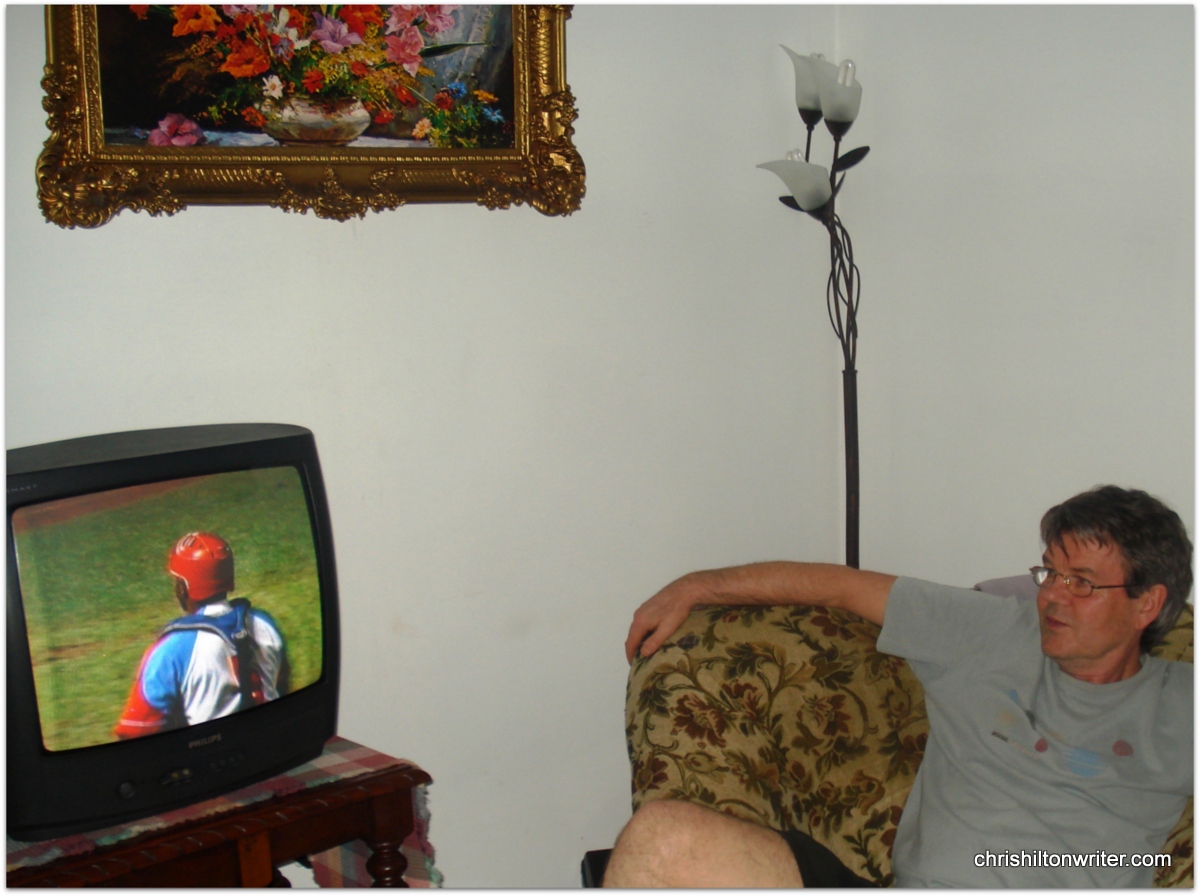
Cuban television is great. There are five channels (I think) – I can only ever find three with regularity – but I live in a flat with poor reception. I don’t watch much TV in the UK; I’m very, very fussy.  I can’t stand advertising of any sort, so watch mainly the BBC channels or, if occasionally I want to watch a commercial station, I edit out the adverts before watching. I don’t have SKY or any other non-traditional station. Cuban TV has no adverts, none whatsoever.


It is a mixture of imported stuff and home-grown Cuban stuff, mainly documentaries. It is twenty four hours now, which it wasn’t back in the early noughties. Strangely, there is a mass of United States’ imports: everything from reality shows, weight loss programmes, cartoons, crime shows and films – everything. US programmes are shown regardless of content. Life is shown as the Americans want it to be shown; it is repeated here as though it is something that exists, but is nothing to either envy or comment on.


The news is pretty biased. Every country has a prejudice towards itself, but Cuba is quite extreme. The news programmes, although not so plentiful as they are here, tell you next to nothing about the outside world. Every broadcast has masses of stuff about Cuba: a technological advance, a meeting somewhere discussing something important, somebody has been awarded a certificate; very occasionally there will be some mild criticism. But there are only two main hour long news programmes per day with a few fillers in between. Foreign news is given about two minutes on a normal day, perhaps longer if anything noteworthy has happened. Sports news is hard to decipher; there is much about baseball, anything else that Cubans have been doing: swimming, judo, football, but I find that for long periods the announcers just talk; of course not understanding ninety per cent of what they say doesn’t help, and they seem to talk for much longer without showing any images – I noticed this on all the programmes; there seems to be much more dialogue, they stay in scenes for much longer. This applies to a whole variety of broadcasting because although much of their television is from the US, there are also Brazilian and Argentinean soap operas, English programmes; it seems to be a Latin American thing – needing many more words to say the same thing. There is an hour long discussion programme just before the evening news, where events of the day are debated at length.


Apart from that there is an eclectic mixture. There has been something on China every day (a pending deal?), but that may not be so unusual – back in the UK there have been many programmes on China too. Strangely, bearing in mind the bias of the news, US television makes up about a third of the broadcasting. It is not censored at all. Whereas the internet is practically banned here, so that Cubans cannot learn what is going on in the outside world, US television provides a constant reminder that just across the water, life, apparently, is much easier. It seems that the way of life is regarded as inferior, nothing to be sought after, just here for your amusement. Of course Cubans don’t entirely believe in the US stuff. It’s treated as propaganda; for all the wealthy, happy people, the news sometimes points out that there is no free health care, that millions live below the poverty line, that the economy is collapsing and life is not at all as it is represented most of the time.


The TV is very well organised now, and professional. There are many, many films, often very recent, more recent than those available to me in the UK. Sunday is film day on one of the stations, twenty four hours of film, at least half very recent. When I first came to Cuba there were only two stations, and the schedule was fairly disorganised. In many ways I preferred that – you never knew what you were going to get, but it was often interesting – perhaps a two hour documentary about Bob Marley as a kid’s programme,TVCuba followed by a film, followed by sport. Children are very well catered for and treated as mini-adults. There is still no advertising here (although they advertise themselves a lot), which is fantastic for me. I do fear that soon they will change that, though. The economy desperately needs a boost, and I’m afraid that advertising will do it no harm. Perhaps they will manage to do it tastefully. I hope so.


“There are 150 books which contain everything that literature has to offer”

In the film Before Night Falls, about the life of poet Reinaldo Arenas, his poor background and persecution at the hands of security police in Cuba, there is a scene where he visits the library of a wealthy Cuban writer, José Lezama Lima.

Arenas has just come second in a national competition; according to the film he should have won. Limas says to him:

‘People that make art are dangerous to any dictatorship. We create beauty, and beauty is the enemy. Artists are escapists. Artists are counter-revolutionary and so you are counter-revolutionary, Reinaldo Arenas, and do you know why? Because there is a man that cannot govern the terrain called beauty, so he wants to eliminate it. So, here we are: 400 years of Cuban culture about to become extinct, and everybody applauds.’

‘There are 150 books that contain everything that literature has to offer. Read them and you don’t have to read anything else.’

‘So what will be the first?’

‘The Bible. You have to read the Bible. Just read it like a novel. I’ll tell you what. I’m going to give you five books. Correction, I’m going to lend you five books. You return them and I’ll give you five more.’

The five books chosen by Lima are Sentimental Education, Flaubert; Remembrance of Things Past, Marcel Proust; Metamorphosis, Franz Kafka; Moby Dick, Herman Melville; Treasure Island, Robert Louis Stevenson.

Now, I have read the Bible, not much, but some and I liked it. But I am not able to judge it either way and am happy to take the word of those who have read it and decided that it is great literature.

Sentimental Education is said to be best novel of the nineteenth century. I’ve read it twice, find it acceptable, but without its reputation I don’t think I would bother with it. There is too much that lacks interest; everybody is too concerned with financial dealings; I couldn’t (even after two readings) keep track of everybody; a revolution was going on while the second half of the main story played out, but I remained as unaffected by it as the author. I know Flaubert was obsessed with finding the mot juste – the perfect word; that he was one of the first authors to ‘show don’t tell’. He once said

‘Around man all is shadow, all is emptiness. The moment I don’t have a book on hand or dream of writing one I could howl with frustration. Life is tolerable to me only if one can conjure it away.’

I didn’t care about Frédéric, about Madame Arnoux or Sénécal; his novel had no effect on me.

Remembrance of Things Past, I’m trying to like, people keep saying you must read this but I don’t like it. I don’t want to go too deeply into why I don’t like these books; perhaps it’s because I see them as anti-life – especially Kafka – just to say here that I do not like them. I have tried three times to get into Proust (I will probably re-try the other authors, but Kafka has probably defeated me). I was just thoroughly bored.

Metamorphosis is difficult. I find all of Kafka unreadable (apart from his letters to his girlfriend). I can barely read one sentence of him. I’ve attempted to read other stuff. I’ve tried The Trial; I appreciate the sentiment, one man caught up in a swirl of bureaucracy, but I can’t read it. I’ve even tried the graphic novel. Believe me, I’ve tried. I don’t like Kafka.

I read Moby Dick when I was still at school, then recently tried again. I enjoyed parts of it but they were few and far between. As Clive James said,

‘Melville’s ocean clung like tar. It’s one of those books you can’t get started with even after you have finished reading.’

But the filmmakers chose those five. After seeing the film (which is great), I tried to read Lima’s Paradiso. It was the only novel he wrote (he was a poet) and I can see why. Arenas too, was a poet, but he wrote some fiction too, all of which I find unreadable. This is not to say that I am right and the writers or their critics are wrong. It is a matter of opinion.

Treasure Island I’ve only read once (and fairly recently). I liked it, maybe because it was meant to be a children’s story or a tale to be taken at face value, perhaps because it’s a

‘tale [that] sprang, effortlessly, from his pen at the rate of a chapter every morning.’

Perhaps I liked Jim’s sneaky heroics, Long John Silver’s survival instincts or Dr Livesey’s steady, cheerful demeanour. It doesn’t matter why I liked it or why I disliked the others.

They could have chosen five different books for the film, for example, The Wings of the Dove, Little Dorrit, Anna Karenina, Middlemarch and The Great Gatsby, to name just five; there are many more I could have chosen. I won’t name them here because I’m sure you have your own choices. I’d like to hear what they are. And Lima chose 150 books; he chose five at random. Perhaps it’s just a coincidence that three of the five are my least favourite books, a fourth very close and only the fifth rescued the scene (in my eyes).

There is something life-denying about four of the books, excepting Treasure Island (and the Bible of course). Perhaps it’s an attitude to life; an attitude that life isn’t worth living. I would like to add other authors to the list. My list is very conservative; I wanted to make sure that my writers were literary greats: I think James, Eliot, Dickens, Tolstoy and Fitzgerald are greats in anyone’s language.

Perhaps story should be king, as it is (I think) with the five writers I have mentioned. Perhaps I am too stupid to ‘getKafka, Melville, Proust and Flaubert. I don’t know. But the scene in the film stayed with me; it’s now seven years since I saw it and I return to it every two years or so.

What do you think?

Who’s Your Muse?

the_MusesIn my last blog, Write or Type, I quoted John Steinbeck, who always wrote longhand, discussing his pencils, where, almost incidentally, he said that

“sometimes when I am writing I am very near to a kind of unconsciousness.”

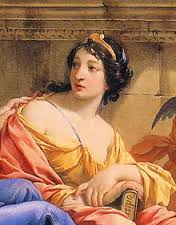
That ‘kind of unconsciousness’ has mystified artists for thousands of years; even the Greeks, where muses originated, could not agree on what muses are. Many writers acknowledge a debt to muses, the mysterious source of inspiration; muses are an attractive idea (to men anyway), beautiful goddesses bestowing wisdom on mere mortals at their whim, possessing all the world’s secrets but giving only small snippets to those who wish to tell truthful stories of human existence.

Do you need inspiration to work, or at least produce work that satisfies you? Or do you believe that everything is about technique, planning and hard work, that the muses are just a pleasant fantasy, adding mystery to what is a job like any other, that can be learned and mastered?

Not all writers have faith in the muse. Flaubert distrusted them. William Golding thought the idea of inspiration ridiculous. On being asked about DH Lawrence’s statement

“Never trust the artist, trust the tale”

he replied

“Oh, that’s absolute nonsense. The man who tells the tale, if he has a tale worth telling will know exactly what he is about, and this business of the artist as a sort of starry-eyed, inspired creature, dancing along with his feet above the surface of the earth, not really knowing what sort of prints he’s leaving behind him, is nothing like the truth.”

While I agree with much of what Golding says – the successful ‘starry eyed’ artist is rare – he does ignore the fact that the man who knows ‘exactly what he is about’ can still receive help from a source he does not know ‘exactly’, help from the unconscious, from the muse. Was Golding a writer who used his intelligence and ability only, always aware of exactly what he was doing, planning meticulously and never changing direction due to flashes of inspiration? Are writers divided between those who believe that they are sole creators and those who admit to outside help?

Gerard Manley Hopkins thought inspiration

“a great, abnormal mental acuteness, either energetic or receptive.”

I haven’t found much on what women think about muses, if they think in those terms at all, although Anais Nin believed that

“this dangerous alchemy called creation, or fiction, has become as dangerous for me as the machine.”

I’ll try to discover what women think about this subject (I’m sure the information is available), but would also like to hear from women writers about their belief, or lack of it, in muses and inspiration.

I do believe that good writing is the result of hard work, but also that during that hard work, inspiration can take over, providing mysterious insight, its origins not fully understood. It can change the direction of stories, give characters a life of their own, produce tales that were not consciously planned. I do like to think of the muse as female (mostly) but my sources of inspiration can vary according to mood, a bit like belief in an unidentifiable God – something is always there, you have faith in it, but you don’t know what it is.

The nine Greek muses were female: Calliope (Epic Poetry), Clio (History), Erato (Love Poetry), Euterpe (Music), Melpomene (Tragedy), Polyhymnia (Hymns), Terpsichore (Dance) Thalia (Comedy), and Urania (Astronomy). calliopeThere was no muse for novelists at that time due to them not existing, so I suppose Calliope represented the muse that would most likely provide inspiration for writers today. Calliope was a superior muse. She kept the company of kings and princes in order to impose justice and serenity, was the protector of heroic poems and rhetoric art. According to myth, Homer asked Calliope to inspire him while writing The Iliad and The Odyssey.

Stephen King has both experience and success. He possesses a fantastic imagination, and the ability to translate it into wonderful stories that appeal to millions of readers.  Although he is not a starry-eyed dreamer, far from it, he nevertheless gives credit to outside assistance. While his muse may not have the allure of scantily clad Greek beauties or Calliope’s obvious brilliance, there is no doubting King’s belief in its existence

“If you don’t want to work your ass off, you have no business trying to write well. There is a muse. Traditionally, muses were women, but mine’s a guy. He’s not going to come fluttering down into your writing room and scatter creative fairy-dust all over your computer. He lives in the ground. He’s a basement guy. You have to descend to his level, and once you get down there you have to furnish an apartment for him to live in. You have to do all the grunt labour, while the muse sits and smokes cigars and admires his bowling trophies and pretends to ignore you. Do you think this is fair? I think it’s fair. He may not be much to look at, that muse guy, and he may not be much of a conversationalist (what I get out of mine is mostly surly grunts, unless he’s on duty), but he’s got the inspiration. It’s right that you should do all the work and burn all the midnight oil, because the guy with the cigar and the little wings has got a bag of magic. There’s stuff in there that can change your life. Believe me, I know.”

King typically stresses the relationship between hard work and the support of his muse. The fact that hard work is essential is stressed repeatedly in King’s excellent On Writing. Another straight talker, Steven Pressman, also puts it succinctly

“Sometimes we baulk at embarking on an enterprise because we are afraid of being alone. We’re never alone. As soon as we step outside the campfire glow, our muse lights on our shoulder like a butterfly.”

Pressman quoted Somerset Maugham

“I write only when inspiration strikes. Fortunately it strikes every morning at nine o’clock sharp.”

Maugham, said Pressman, recognised a deeper truth

“that by performing the mundane physical act of sitting down and starting his work, he set in motion a mysterious but infallible sequence of events that would produce inspiration, as surely as if the goddess had synchronised her watch with his.”

Pressman adds

“The muse favours working stiffs. She hates prima donnas.”

John Lennon, while not identifying his help, or recommending hard work, said

“So I’m lying around and this thing comes as a whole piece, you know, words and music, and I think well, you know, can I say I wrote it? I don’t know who the hell wrote it.”

The comedian John Cleese, on being asked where he got his ideas, said

“A little man in Swindon gives them to me, but I don’t know where he gets them from.”

Despite writers’ strange and diverse beliefs: Cleese’s little man in Swindon, King’s cigar smoking slob or Anais Nin’sdangerous’ alchemy – one thing is certain – whomever or whatever your muse is, they will not come and they won’t help until you have put in the work. They will sit idly by, holding back your secrets, your tales yet to be told, secure in their ability to pluck wisdom, genius or just a good story out of the air and, when you have worked and suffered and you’re close to giving up, they might, just might, if they like what you’re doing, give you a little help.

Who’s your muse?


Note:

If you choose only two books to help you to write, not only to write, but perhaps more importantly to develop a system of work that, providing you have sufficient talent, will give you a fair chance of success, then I recommend Steven King’s On Writing and Steven Pressman’s The War Of Art. Both books give brutally honest advice and I strongly recommend them to any aspiring writer.

Write or type?

penI am fascinated by how writers write and how the process of writing has changed with the advent of technology, from the pen and typewriter which dominated until comparatively recently, to now, where in theory, one could write a novel on a tiny handheld phone. Some writers still write in longhand, believing that they work better that way, sometimes for practical reasons: to avoid distraction or because pen and paper do not need batteries, but also because they feel there is an intangible relationship between mind, hand, implement and creation.

Stephen Fry’s recommendations for writing poetry include:

“Buy a notebook, exercise book or jotter pad and lots of pencils (any writing instrument will do but I find pencils more physically pleasing).”

JK Rowling says she

“still likes writing by hand. Normally I do a first draft using pen and paper, and then do my first edit when I type it onto my computer. For some reason I prefer a black pen to a blue one, and in a perfect world I’d always use narrow feint writing paper.”

Jackie Collins’s Goddess of Vengeance comprised of 2000 handwritten pages. An assistant then types the work and Collins edits that version. She says

“I write in longhand. It takes me a long, long time to write my books. I do a lot of things on the computer but when it comes to writing I want that black felt tip pen and I want that yellow legal pad and I’m good to go anywhere in the world.”

Cecilia Ahern, author of PS I Love You, uses

“pen and paper because I love the physical act of writing – and that you can sit down anywhere and do it longhand without worrying about low batteries or Internet connections. I can write pretty much anywhere.”

These writers stress the practicality of longhand but are also specific about what they prefer: Rowling’s ‘black pen and narrow feint writing paper’, Collins’s ‘black felt tip and yellow legal pad’, while Ahern emphasises ‘the physical act of writing’. There seems to be, for some writers, a relationship between brain, hand, implement, paper and, crucially, what is actually written, something corporeal but mysterious that affects what eventually appears on a mechanically printed page.

Many writers admit when asked that most common of questions

“Where do your ideas come from?”

that they don’t know. Stephen King says

“and we know we don’t know…your job isn’t to find these ideas but to recognise them when they show up.”

Ideas have ‘shown up’ to writers ever since people have told stories; before writing was reproduced and printed, stories were told from memory. Until very recently, mechanical aids were not used for writing; Shakespeare, we know, used a quill pen. It was said that he never blotted a line,

“Would that he had blotted a thousand”

said Ben Jonson, a statement of both envy and respect.

Even in the office “paper still matters” according to Phyllis Korkki in the New York Times. She cites David Allen, author of Getting Things Done, describing paper as

“in your face. Paper reminds us that we’re physical beings, despite having to contend with an increasingly virtual world,”

he said

“People complain that writing by hand is slow, but that can be good for thinking and creating. It slows us down to think and to contemplate and to revise and recast. Its physical presence can be a goad to completing tasks, whereas computer files can easily be hidden and thus forgotten.”

Some of his clients are returning to paper planners for this very reason. Although Allen does much of his writing on a computer, there are still times when writing with a fountain pen on a notepad

“allows me to get my head in the right place.”

Getting one’s head in ‘the right place’ is a difficulty most of us experience daily, but for a writer, having one’s head in the wrong place is probably the greatest obstacle to creation. So does the method of writing affect the process of getting the head in smooth writing mode? And what is the right place? To simplify matters for my purpose here, let’s just describe it as that blessed state where writing flows effortlessly. And to simplify further let us abandon the office, journalism too, and concentrate on the novelist.

John Steinbeck, in his Journal of a Novel, described writing as

“a strange and mystic business. Almost no progress has taken place since it was invented. The Book of the Dead is as good and as highly developed as anything in the 20th century and much better than most.”

Steinbeck always wrote longhand with pencil and felt that

“sometimes when I am writing I am very near to a kind of unconsciousness.”

That unconsciousness may well describe those periods when something else takes over (the Muses?) and we write as if driven by something other than ourselves, when a story becomes autonomous and seems to unfold in a way that it decides, rather than being controlled by the writer. In 1951, when Steinbeck wrote East of Eden, he could have used a typewriter. Did he, like many other writers, even today, find that writing flowed more through this relationship between hand, implement and paper than via a machine?

Steinbeck certainly had a minor obsession with pencils. In his Journal of a Novel, the diary he kept of the process of writing East of Eden, he wrote

“For years I have looked for the perfect pencil. I have found very good ones but never the perfect one. And all the time it was never the pencils but me. A pencil that is all right some days is no good another day. For example yesterday, I used a special pencil soft and fine and floated over the paper just wonderfully. So this morning I used the same kind. And they crack on me. This is the day I am stabbing the paper. So today I need a harder pencil. I have my plastic tray you know and in it three kinds of pencil for hard writing days and soft writing days. Only sometimes it changes in the middle of a day, but at least I am equipped for it. I have also some super soft pencils which I don’t use very often because I must feel as delicate as a rose petal to use them. And I am not often that way.”

Steinbeck complained that pencils were a great expense to him and that he used at least sixty a day. His best friend was the electric pencil sharpener,

“I have never had anything that I used more and was more help to me. I like to sharpen them all at once and then I never have to do it again that day.”

But he had another motive:

“I have lost the sense of rush with which I started and that is exactly what I intended to do.”

If, as Steinbeck suggests, no progress has taken place in writing since The Book of the Dead, does how we write make any difference? Will technology, the ease with which the physical book can be produced, along with automatic spelling and grammar checks produce better or worse writers? And does writing with pen or pencil improve one’s writing? Is it an aid to thinking and inspiration?

Half of the chapters in my first book were written with pen and paper. I use a Grey Pilot V5 Hi-Tecpoint 0, 5. I find the effect very similar to a pencil and of course it never needs sharpening and is good for a hundred pages or so. I keep a constant supply, always having at least ten in reserve. I can’t write with anything else; I find writing with a ballpoint resistant to flow. I do love pencils but can only write a few lines (I press too hard) before a sharpener is needed to restore a pleasing feel and appearance to my words.

Orhan Pamuk, the Turkish Nobel Prize winner for Literature, uses a graph paper notebook. He writes one full page, and then leaves the next page blank for revisions. I too like this method. Despite using a computer most of the time now, I still prefer to edit on paper, printing off a few pages and making changes with a red pen before adding them back into the screen version. I find reading and editing much easier on paper; everything is much clearer to me and the edits feel more satisfying that way – they feel right. There is certainly something very natural to writing on paper, something lacking on the screen, and I feel it’s much easier to miss errors on screen, errors which leap off the page on paper. Despite their convenience, particularly for holiday reading, I am unable to read more than a few pages of books using a Kindle or other software aids. I get no pleasure from it – something important is missing.

Kazuo Ishiguro, the Japanese-British novelist, organises and writes his novels with pen and paper. Only when the novel is complete does he type his own pages; before that he uses flow charts, folders of narratives, plot and narrators in a two year process – all hand-written with edits in pencil. John le Carré prefers to write his novels in longhand; he says that he’s allergic to computers. He writes from 4 a.m. until midday, when his wife types up the day’s work. All Le Carré’s papers were kept in a barn until he donated 85 boxes of manuscripts to the Bodleian Library at Oxford. Much can be learned from paper manuscripts about a writer’s methods and thought processes that cannot be easily discovered from a computer. Of course, once deciphered an archive can be simplified and made available on line, but that archive would not be available in the first place without the meticulous, handwritten record.

Many of my ideas and parts of stories are in notebooks which are easily found and referred to. I find these much more accessible than those in my computer, where I have more than a thousand files containing one-line ideas, chapters, potential blogs, articles and short stories. I sometimes find stuff on my computer that I think is good and wonder who the author was, then I realise that I wrote it, often many years previously. Opening a computer folder full of files, I can’t remember what work goes with the titles given to each piece and it is very time consuming to open and check each file, whereas flicking through the pages of labelled notebooks is easier, quicker, more efficient and satisfying. For me it is, anyway. I’m sure the technically proficient could show me more efficient ways of storing work on a computer, but I think I would still come across five year old work that I’d forgotten about that would have been worth pursuing. Perhaps I’m just hopelessly disorganised and anti-technology, but I find books and notebooks a better method of storing and retrieving information.

Bestselling author Tess Gerritsen blogs on the computer, but for novels, only pen and paper will do. She uses a Bic pen and sheets of unlined paper. Comfortable composing articles at the keyboard, she struggles with novels, finding that she wastes too much time

“perfecting them.”

Gerritsen appreciates pen and paper for its physical properties:

“I like knowing that once the ink’s on the page, it can’t magically disappear when the power goes out. I like being able to write notes in the margins.”

This is not to suggest that everybody should suddenly revert to using pens and pencils. Nor am I implying that those writers using longhand are better writers, or that keyboard writers are worse. I am merely theorising about the mysterious source of inspiration (my blog on Muses) and its possible relationship to the physical process of actual writing, rather than typing.  Computers are fantastic aids to general writing, for most business uses, for journalists, for articles and those with deadlines.

Whether one writes longhand or not, pens and notebooks remain indispensable; I always carry both. Watching TV, I have an open notebook beside me for those ideas which come from the news or drama or just arrive from nowhere. You think

‘that’s a great idea. I’ll work on that later’

but you won’t – you’ll forget. The best ideas come only once; they vanish as quickly and easily as they arrive. They must be recorded somewhere, quickly. Perhaps some writers make notes in their phones or other gadgets, but what if the idea needs expanding? You can’t draw arrows, margin notes and fast alterations with a gadget. Not yet anyway.  Writers who use longhand speak vaguely of a physical relationship, physical properties, hard and soft writing days, the physical act of writing, a physically pleasing aspect. There is something there, but we are not sure what it is, how to describe it or why it helps. What I am getting at here is that the pencil (or pen) is an aid to the imagination. It is certain that even some modern novelists still prefer to write this way; when it comes to creating something more than the quotidian it appears that for some, only pen and paper will do.

Lists, rules and things to do

lists-001Do you make lists of things to do and then make rules for carrying them out?

Do you find writing lists easy and fun?

Does writing a list make you feel as though you’ve achieved something?

Do you come across old lists and rules that you’ve written down, and then realise that you haven’t done a single thing about them?

Are you beginning to despair, feeling that you’ll forever be a writer of lists and nothing more?

Take heart.

Below is a writer’s list of things to do. The writer’s response to what was achieved is in italics.

Take a guess as to the identity of the writer before it’s revealed.

 •••

 1)     Study the whole course of law necessary for my final exam at university.

2)      Study practical and theoretical medicine.

3)      Study languages: French, Russian and German.

4)      Study practical and theoretical agriculture.

5)      Study history, geography and statistics.

6)      Study mathematics and the grammar school course.

7)      Write a dissertation.

8)      Attain an average degree of perfection in music.

9)      Acquire some knowledge of natural sciences.

I have not managed to do these things.

•••

New List

Write down new rules.

I wrote down a lot of rules all of a sudden and wanted to follow them all, but I was not strong enough. So now I want to set myself one rule only and to add another rule to it only when I’ve followed that one.

The first rule which I prescribe is as follows:

1)      Carry out everything you have resolved must be carried out.

I haven’t carried out this rule.


 •••

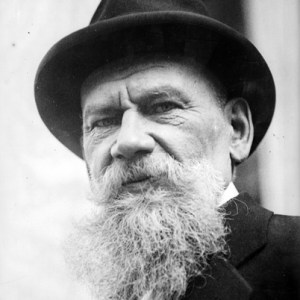
The lists above were taken from Tolstoy’s early diaries when he was a student at the prestigious Kazan University. Tolstoy was a bad student, the beginning of a lifelong contempt for authority. He behaved very badly and then castigated himself in his diaries.

 “He had a raging uncontrollable spirit leaping off in all directions.”

97i/43/huty/9230/09

Tolstoy


But he did not lack ambition. He had rigorous plans, parts of which are related above. Tolstoy was forever making lists and plans and promises to himself to be the strongest, the cleverest, the most saintly model of manhood. However, in diary entries that remind you more of Adrian Mole than a future literary giant, he discovers that writing lists is the easy part.

I find it enormously encouraging that the writer of War and Peace and Anna Karenina had similar problems getting started that I suspect most of us do. It certainly prompted me not only to write fewer lists, but to make much more effort to actually carry them out and, crucially, not make promises to myself that I don’t keep.

I hope it inspires you too.

More on Tolstoy later.

Too much information

“Distraction is the barrier through which a writer must force his way.”

Saul Bellow

Saul Bellow, in a lecture at Oxford University, said that a typical ‘quality’ newspaper, the London or New York Times, for example, contained considerably more information in one day than even an educated Elizabethan absorbed in an entire lifetime:

“I suspect that an Elizabethan was less confused by what he saw. He would certainly have been less agitated than we are. His knowledge cannot have laid him so close to the threshold of chaos as ours.”

That was in 1990, the Dark Ages in technological terms. How much more information do we absorb today, with the 24 hour bombardment from television, the Internet, Smartphones, iPads, radios and the printed media? More than we are designed to absorb? Can writers rise, clear-headed, above the fray and actually observe their world dispassionately before relating it back coherently to readers and, if they can, will their views be obsolete as quickly as a new phone?

Saul Bellow considered himself above the fray. Although he admitted to a certain daily addiction to ‘the news’, he was more concerned with how to get through to an increasingly distracted audience,

“The concern of tale-tellers and novelists is with human essences neglected and forgotten by a distracted world.”

Surely even Bellow, who died in 2005, would struggle against distraction today.

In 2008 Nicholas Carr wrote an article entitled Is Google Making Us Stupid? Much has been written since on this and related topics, indeed Carr expanded his article into a book, and then another, but I believe this early, brilliant and perceptive article provides most of what we need to know. Carr claimed that the Internet

 “…is chipping away my capacity for concentration and contemplation. My mind now expects to take in information the way the Net distributes it: in a swiftly moving stream of particles. Once I was a scuba diver in the sea of words. Now I zip along the surface like a guy on a Jet Ski. I now have almost totally lost the ability to read and absorb a longish article on the web or in print.”

Carr cites a study of visitors to the British Library research sites, which provided access to journals, e-books and other sources of written information. It was found that people exhibited:

 “…a form of skimming activity, hopping from one source to another and rarely returning to any source they’d already visited. They typically read no more than one or two pages of an article or book before they would bounce out to another site. Sometimes they’d save a long article, but there’s no evidence that they ever went back and actually read it.”

Users would,

“power browse horizontally through titles, contents pages and abstracts going for quick wins. It almost seems that they go online to avoid reading in the traditional sense.”

Rolling news requires that the viewer watch and listen to material that has been repeated hundreds of times already, and is being constantly repeated elsewhere, while also reading about ‘breaking news’ being transmitted in text across the screen, probably with a view of a busy newsroom in the background where newshounds scurry back and forth, dedicated to providing the viewer with news of everything that is happening in the world, as it happens.

Mastering the delights of technology gives the illusion of control. But, for many, is it just an avoidance of life ‘out there’ rather than participation within it? We have the illusion that we are on top of everything, but what, apart from the ability to use gadgets, do we have control of? Since succumbing to a Smartphone I’ve found distraction has increased ten-fold, where once I was available only to calls and texts, now I’m available for everything – always.

Henry James advised writers

“to try to be one of those people on whom nothing is lost.”

Wise and true, I believe, but an Einstein-like big brain is now needed to hold and make some sense of all the information available.

Michael Foley wrote in his excellent The Age of Absurdity (2010) that

“My television and laptop both behave as though they are on first name terms with their owner and have intimate knowledge of his personality and tastes. Nowhere is safe now. I visit my dentist where for, for decades, there has only been dog-eared magazines with missing covers and find a music centre behind the reception desk, a television in the waiting room and a radio playing in the surgery.”

 ***

When Harper (Nellie) Lee and Truman Capote were researching Capote’s In Cold Blood, his ‘factual’ novel about the murder of a wealthy Kansas farmer, his wife and two of their children, they took thousands of pages of notes, interviewing and often befriending residents in their homes. They encountered an unanticipated problem: trying to keep people’s attention away from the TV,

“The nuisance of manic commercials in the background tested Nelle’s and Truman’s patience, especially when the whole point of an interview was to try to talk intimately with someone.”

NBC had recently begun broadcasting from Garden City. It was 1959. Neither Lee nor Capote owned a TV because

“It interferes with work.”

The average American is now subjected to over 3000 advertisements per day. The rest of the world cannot be far behind.

Distraction is nothing new: Virginia Woolf’s dress could be so careless that, according to Quentin Bell, her

“drawers would literally fall down”

and on one occasion,

“everything dropped”

as she was saying goodbye to guests at the door. GK Chesterton once sent a telegram to his wife, saying

“Am in Kettering. Where am I supposed to be?”

Of course their distraction was of a different kind: internal; they had both probably been mentally composing an essay or a novel at the time – this is the internal distraction of the quintessential artist, not the external distraction of modern life.

So how can writers overcome not only today’s distraction of 24 hour information but the noise that accompanies it?

In the 1880s the French poet Jules Laforgue believed that

“the modern world has embarked on a conspiracy to establish that silence does not exist”

and, like Proust, soundproofed his room with cork. Kafka thought that:

“One can never be alone enough when one writes, why there can never be enough silence when one writes, why even night is not night enough.”


NM

“I used to have a little studio in Brooklyn, a couple of blocks from my house – no telephone, not much else. The only thing I ever did there was work. It was perfect. I came in ready to sit at my desk. No television, no way to call out. Didn’t want to be tempted. There’s an old Talmudic belief that you build a fence around an impulse. If that’s not good enough, you build a fence around the fence.”

Wordsworth said that poetry comes from emotion recollected in tranquillity. The tranquillity available to him may have gone forever, but it does not mean that it cannot be found. I find I have to go to expensive extremes to get any serious writing done.  I must have some form of peace to write. I don’t need to be distracted to be diverted from writing. I can do that by myself. If there were an Olympic discipline in prevarication, I’d have a great chance of a medal – although that might be an event with a poor turnout. I planned and wrote by book from home, completed a synopsis and a few chapters and sent them away. When a literary agency told me that they would find me an agent if I could turn my draft into 300 pages of flowing text, I knew there was only one way to do it: get on a plane and go somewhere where I might be able to work without distraction.

bali-001

My Bali writing hole

The first half of Caliente was written in the garden of a cottage in Bali, the second half at a villa in Havana. An expensive and indulgent way to get one’s writing done, I agree, but it wouldn’t have happened otherwise. I can’t blame technological distraction entirely for that, but escaping it was nevertheless a part of the process; in neither place did I log on to the Net apart from morning emails from an Internet café in Bali, and in Havana from hotels with Internet access. I left my phone at home. I don’t regret my decision. I wanted to get the book written and I would have done anything to achieve it.

chriscuba-001My second book will take shape during August, in Havana. It will be extremely hot so I will spend the days in air conditioned isolation while I write for 6 to 8 hours per day, before enjoying a cooler, well-earned night out with friends. To complete the book I will probably need to find peace and isolation again. That peace might need to be found closer to home – a cottage in Wales perhaps – and more frugal writing sites may soon become a necessity. Like Michael Foley, I find much of modern life absurd. I have to escape from it before I can write about it.

Victor Hugo did it Naked

Victor Hugo did it naked, standing at a lectern facing a third floor window of his Guernsey home, overlooking St Peter Port harbour. Tennessee Williams couldn’t stop doing it and worried constantly about it. George Orwell thought it “a horrible, exhausting struggle, like a long bout of some painful illness”, while Evelyn Waugh required “merely silence” to do it; he preferred his children to be “away”. John Lennon thought it ‘torture’ and GK Chesterton believed there was only one way to do it.

penFor many authors, writing is not a pleasurable experience, although Victor Hugo may have discovered a fun element.

Why am I writing about writing? Well, I’ve written one book and I’m desperately trying to write a second. I didn’t begin writing my first until into middle-age and it took me a few years to complete.  I’d always wanted to write, so why did it take me so long?

Because I will do anything rather than sit down and write; tasks I normally hate: cleaning, paying bills, laundry, suddenly take precedence over writing, even though it’s the writing and the ideas for writing that are constantly swirling around in my mind. When I finally force myself to write, the early stages are the hardest, the period when nothing will come, when I believe I’m an utter moron and question my ability: “who are you kidding, thinking you can write?” This is often the stage where I just have to do that extra piece of research, read the latest book on how to write or the latest author biography, switch on that must-see TV programme – or just give up and open a bottle of wine.

But why is writing so hard?

John Yorke, in his recent book Into the Woods, shows that stories follow a pattern, a common structure. This is not a new idea, far from it, but Yorke believes that the archetypal structure matches deep psychological needs within us all: order from chaos, characters changing, confronting their demons to become the people they were always capable of being. This supplies a need for the reader, who is comforted by the process, identifying with the character that brings order from turmoil, confronts and slays the enemy. The detective story is a perfect example: a problem is solved; there is resolution. Most of us do not confront what we fear; we hide and play it safe. This explains the hunger for stories, be they in books, films, soap operas or reality TV shows: secret fears are confronted and overcome.

I have oversimplified outrageously, but I believe that for many writers the process of sitting down and writing is also, like story structure, a confrontation with the enemy: self-knowledge, not only in the sense of revealing oneself but in conquering doubts over one’s ability. In practical terms writing should be easy, you just sit down (or stand naked at a lectern) and do it. But it isn’t easy. Steven Pressfield in The War of Art puts it bluntly:

“How many of us have become drunks and drug addicts, developed tumours and neuroses, succumbed to painkillers, gossip, and compulsive smart-phone use, simply because we don’t do that thing that our hearts, our inner genius, is telling us to? Resistance defeats us.”

I love the idea of writing, I want to write but hide from its practice, unless … unless I force myself to sit and write, probably awful stuff, for at least an hour. Then, miraculously, something happens – not always, it’s not that easy – and the awful stuff begins to make sense: it flows, ideas appear from everywhere, ideas that had been locked away, ideas locked away by me while I resisted and wasted my time, pour onto the page, ideas I didn’t know I’d had; plots change, characters change, and for a blessed few hours I am creating something, something worthwhile and I am enjoying writing. But that initial process of beginning – it’s hard, and I resist it much more often than I embrace it.

The truth is that writing is very hard work; you have to be dedicated and professional to keep going. Norman Mailer put it well:

“One must be able to do a good day’s work on a bad day, and indeed, that is a badge of honor decent professionals are entitled to wear.”

Apparently more than 80% of people say they want to write a book, but less than 1% do. Not all those would-be writers have the ability to write – The X Factor shows us that believing you have talent and actually possessing it are two very different things – but I’m sure there are many talented people among that group telling themselves every day that they will start that novel tomorrow or next week or after they’ve finished researching the history of Florentine art for that Renaissance murder mystery they’ve been planning for five years. Steven Pressfield, straight as ever, gets right to it:

“We don’t just put off our lives today; we put them off till our deathbed.”

And GK Chesterton’s

“one way to do it”

his method of getting it done?

“Apply the seat of the pants to chair and remain there until it’s finished.”

I’m about to do just that, right after I’ve cleaned those windows, they’re filthy.