Butch Cassidy versus the Accountants

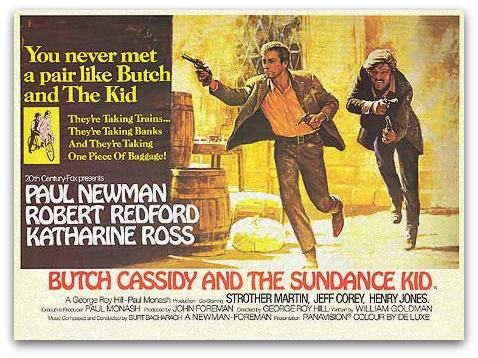
I watched Butch Cassidy and the Sundance Kid recently. I first saw it in 1969 and it had a big effect on me, as did many films of that time. However, most of those films are deservedly forgotten or they were so of their time that they are now unwatchable or they were simply very bad. I was much easier to please in those days. Butch Cassidy is still as good now as it was then, perhaps in many ways, better. One would think that with the terrific technological advances made it would seem dated. That is not the case. It helps that it is a western; there are no outfits or hairstyles to go out-of-date. Films now date very quickly with phones and computers becoming obsolete practically overnight. But really, there is little about this film that shows it was made 45 years ago. It is timeless.
butch-001

The only lack from a spectator’s point of view would be the lack of moving cameras. Perhaps some long shots could have been improved, but only very little. The 27 minute chase scene never gives a close up of the pursuers; in some of the long distance shots you can barely see them, so maybe a slightly closer view would help, but I don’t think it matters. The fact that the pursuers are barely visible makes the whole situation slightly more sinister; it adds mystery.

longshotbutch-001

The three main leads are impossibly attractive and do not seem dated in the slightest. The whole film is full of humour; even the death scene at the end is humorous; you know it’s coming, Butch and Sundance know they are going to die, but they face the inevitable with the same attitude they faced their whole lives with. The film is a celebration of life. Butch is more intelligent than the average outlaw; he spends the whole film running away, not something the average cowboy did – they usually stood, fought and died. Butch and Sundance do their best to find more banks or trains to rob; their day is done but they keep trying. Ten seconds before they die they are planning a trip to Australia. Their pursuers are never really seen: they are the enemy; we identify totally with Butch and Sundance. The last scene was accurate: they faced about 200 soldiers as they made their last stand. All those people to kill two bandits.

I had forgotten how slowly the film starts. I cannot remember if I was bored at the time, but once the chase begins the film is gripping. The chemistry between Newman and Redford makes the film; brilliant lines that everyone remembers:

‘Who are those guys?’

‘Hell, the fall will probably kill you’

and many more. The film is a paean to friendship, friendship to the end. It is wonderful. Remember also that the film was made before a pubic hair had been seen on the screen or a swear word uttered.


George Roy Hill ‘shot’ the film with beautiful scenery and colour, perfect teamwork between the main actors and a great script. The late Paul Newman, speaking on the twenty fifth anniversary of the film in 1994, said:

‘In those days they shot films. Now they shoot schedules, budgets, someone’s bonus or a release date, but that film was shot. That may be why it worked. There was a lot of pressure at the end on George Roy Hill to hurry up the distribution because some southern distributor said he could get a million one out of Texas and Arizona. George lived in someone’s dressing room so that he wouldn’t waste 20 minutes driving to and from the set.’

Robert Redford said that George Roy Hill created space for behaviour and character. He had discipline and knew exactly what he wanted to do. Redford believed the critics missed the core of the movie: bonding and friendship. Actors worked on days off and didn’t let ego get in the way of the film. Redford said that it was

‘The most fun on any film I’ve had.’

I can’t hep but feel that this is analogous to our times, 45 years on. There are too many people managing who don’t know what they’re doing. They are taking an awful lot of money for telling people who do know what they’re doing what to do: in education, health and finance – they are everywhere, but especially in films. With the massive advances in technology, cameras can do anything and most directors overdo the scene switches and close ups. Until about ten years ago only one or two people could edit a film; it was a skilled job. Now anybody can do it and many talentless studio executives do edit films because they don’t like the ending or because, possessing a massive ego and little else, they think they know best. Writing appears to count for very little: we’ll just make up for it with special effects. Writers have rarely been given credit in film, now, in most cases, particularly in the US, they are obsolete or just provide conveyor belt stuff.


Forty five years ago executives tried to interfere with George Roy Hill’s vision for Butch Cassidy. They failed. With technology as it is and a perverse political correctness holding sway, the money men have taken over. Hollywood does still produce some good stuff but it is rare. I would rather watch a Latin American, Scandinavian or French film, costing pennies but showing a little intelligence, than most of what is churned out today.


And if you haven’t seen Butch Cassidy and the Sundance Kid, watch it now. And if you have seen it, watch it again. As Paul Newman said:

‘The film was about the delight of the film maker. All the ingredients have to work. We had a terrific time.’

 

chriscuba-001

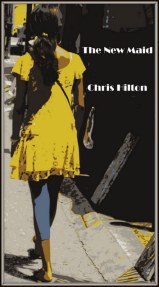
The New Maid – Free Reader Promotion

102-002She left Spain to escape from a domineering family. A new job in London gives her the opportunity to start again: the start of something fresh and exciting or has she just swapped one dysfunctional family for another? A self-obsessed mother, a quiet, flirty husband and a very forward thinking daughter – and a lot of time to herself.

What lies in store for her? How will she cope?

Will it be heaven or hell?

The New Maid: a story of change, new prospects and a kind of redemption.

“…a tale of a maid working for a stereotypical, high class, dysfunctional family. It empathises with the maid as she gets all caught up in the politics of the family. But there is only so much a maid can take…”

Available free through KDP from Decemeber 14th through to Decemebr 19th.

Download a copy now

“a short story which manages to capture so much.”


Amazon UK – The New Maid

Amazon US – The New Maid

I would really like to hear what you all think.

Reading in Bed

“Those of you who have seen my book, whatever you may think of its contents, will probably agree that it is a beautiful object.  And if the physical book, as we’ve come to call it, is to resist the challenge of the eBook, it has to look like something worth buying and worth keeping.”


From Julian Barnes’s acceptance speech at the 2011 Booker Ceremony, on winning with his novel, The Sense of an Ending.

A Guardian article states at length how the book buying public are now being seduced by a book’s appearance as well as its content, how more care is being taken in the production and appearance of books. Generally, I don’t believe this is true.


The Sense of an Ending is a physically beautiful object; a compact hardback with dust wrapper containing a nice but simple design, all put together with good quality material.  I think all books are beautiful in their own way, but that is another discussion.  Barnes’s book is a beautiful object, but how practical is it?  By that I mean how well does it do its job, perform its practical purpose of being read, and being read with ease, without unnecessary hindrances?  The answer to that is: not very well.

IMG_0368

I read frequently in bed.  That may not be where the majority of reading hours are put in, but it is the place where my reading most often takes place – every night without fail.  Actual reading time can be as little as one minute before the object of reading falls onto my face to remind me that I’ve fallen asleep; it can also be hours or occasionally a whole book.  In bed is where one judges the practicality of a book.  I believe most of us must read while lying on our back, holding the book above our face; that way when sleep comes it’s possible to place the book on the floor or on the bedside table and quickly get to perfect slumber without unnecessary interruptions, such as changing position drastically or rearranging pillows, cushions and covers.  If, like me, you do read this way, then you should know what I mean about the practicality of reading a book as opposed to its beauty.


Julian Barnes is right.  His Booker winning novel is a beautiful object; I read it over a few nights, entirely from a prone, on my back, position.  And it is not a practical object.  For a very simple and infuriating reason: its inner margins are too narrow.  The book requires an uncomfortable and impractical two hands to be able to see the whole of the text; in other words, without forcing the book wide open with two hands the inner text on both pages will disappear into the fold of the book; one is constantly tilting the book this way and that to read the end of the sentences on the left-hand page and their beginning on the right hand page.  This is unusual with hardback books, but this is a small book.


Although this fault is most noticeable in bed – I suppose publishers will protest that books are not designed to be read in bed (if not, they should be) – it is almost as annoying when reading anywhere in any way.  If, like me, you love books as ‘physical’ objects then you will resent having to practically break their backs to read the central text.  Apart from the discomfort and the detraction of pleasure, you are damaging the book, shortening its life – the act of doing this, bending the two halves of a paperback hard against its spine makes me angry; apart from the inconvenience which has been added to what should be a pleasure (depending on the book), I resent having to treat a book this way.  It should never be necessary.


Why are so many books made this way?  And who is producing them? I can’t decide if this is just a quirk of printing or penny-pinching.  I was unable to decide if some publishers habitually printed unreadable books, if some never erred or if the whole business is a lottery.  I was going to put together an extensive list but found that margin width is completely random, there is no pattern to it; a publisher may release a book with wide margins followed by one with narrow margins: same price, no reason. It appears to be haphazard. Rather than try to catalogue the problem, here are just a few examples of what I have been reading lately.


Geoff Dyer’s Working the Room (Canongate) is impossible to read in bed without forcing the covers back with two hands (not a natural position).  Using the natural stance of holding the book between thumb and forefinger reveals the bottom half of the text, but the top half disappears into the centre, forcing one to use unnatural, uncomfortable pressure to be able to see the upper text.

A Little Aloud (Chatto & Windus) is not only a marvellous book, its proceeds going to charity, it has really wide central margins to make one-handed reading easy as well as silent or noisy reading in bed – in fact why not read aloud to a loved one in bed?


I had hoped that this would be a modern phenomenon, a sign of the philistinism and greed of the post-modern era, penny pinching publishers saving another £0.0001 per copy by depriving the reader (me!) of reading space and comfort.  It was not to be: A 1998 Penguin edition of Lucky Jim is very mean with its margins.  It requires two hands and needs forcing open at all times because also, without the book open flat there are always shadows to contend with, a hazard for all but those with 20:20 vision.

IMG_0374

Another factor is ‘Give’.  Have you noticed how the better paperbacks allow themselves to be forced flat, you feel as though you are breaking them but you are not – the spine remains uncracked, the glue holds – they are a miracle of design and engineering. I present two examples: Alone in Berlin (Penguin) 2009, and Leviathan (Fourth Estate) 2009; beautifully put together books, but Alone in Berlin has narrow margins while Leviathan has wide margins; they are both priced at £9.99 – the problem has nothing to do with cost. I don’t think publishers even consider this. The Empty Space by Peter Brooke also has ample room on the inner margin.


The crazy thing is: Who needs outer margins? They are necessary for appearance’ sake but provide no practical purpose. Why not shorten the outer margin and give the difference to the inner margin? I hope I’m not the only person to notice this. Any thoughts?


Why do homosexual writers get right to the essence of relationships?

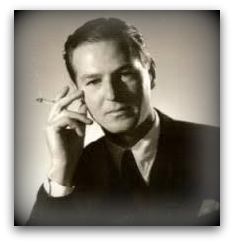
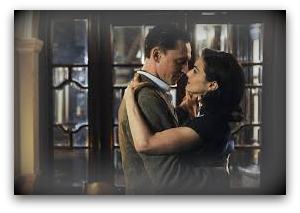
terrancerattigan-001It hadn’t occurred to me before (I don’t know why) how good homosexual writers are with relationships. I recently watched the film version of The Deep Blue Sea, a recent version of Terrance Rattigan’s play. I was very impressed with it and decided to watch something I’d recorded in 2011, an hour long documentary on Rattigan by Benedict Cumberbatch. It was in that interesting documentary that it was stated that Rattigan’s female characters, including, Hester Collier, played by Rachel Weisz in the film, were actually based on men, that at the time the plays were written the characters had to be changed because homosexuality was against the law.

I first came across a Rattigan play in the 1990s. I didn’t know or didn’t register who the play was written by. The play was Separate Tables, including Julie Christie and Alan Bates. The play was very moving. I remember my wife of the time saying ‘You could feel that’, and she was right – you could feel it. I recently watched the play again, but it is of course dated. With the best of intentions you can’t help noticing the hairstyles, the static camera – it’s still a great play but the shine is taken off it. The Deep Blue Sea was my first experience of Rattigan modernised – still set in 50s but with modern techniques. I felt it again. It is a very touching drama in which not much appears to happen.

This reminded me of The Browning Version, another moving Rattigan play. I suddenly realised that Rattigan gets right to the heart of the matter without making very much happen. I had watched an earlier version of The Deep Blue Sea. It was from 1994, televised as a play, but seemed even older. While the performances were good from the actors, including a young Colin Firth, it somehow remained quite static. Of course it was a play, not a film, but keeping the action in one dingy room somehow lessened its emotional impact, which was there waiting to be brought out. The main character, Hester, was also older, or looked it, which also (for me) reduced its effect. Subtle differences were introduced into the 2011 film: The action moved to a pub a couple of times; a musical scene in the pub showed the bond between Hester and Freddie Page (Tom Hiddlestone); Hester’s husband, Sir William Collier (Simon Russell Beale), was shown at dinner with his mother and provided more of a clue to the tension between husband and wife. The changes made for the film, just switching occasionally to the street, a pub, a telephone box, made the action more understandable and believable. The action in both was set in the 50s but the film had somehow made the action seem contemporary. It was very cleverly and sensitively done; I highly recommend the film to anyone who is interested. I have Rattigan’s plays and films in a BBC collection. Through no fault of their own they are dated, losing much of their impact.

hesterandfreddiepage-001The main thing I learned from the plays is that they are very emotional. Separate Tables moved me in 1983 and The Deep Blue Sea was incredibly poignant today; it left a lump in my throat, sent shivers down my spine and, believe me, it takes a lot to do that; I am a cynical person who dislikes ninety per cent of what I see, the pathetic excuses for drama we are now presented with. It takes a lot to affect me. The fact that Rattigan’s original intention in most of his plays was to have a man as the love interest rather than a woman does not lessen their impact, if anything it increases it.

Why do homosexual writers get right to the essence of relationships? Men are obsessed with sex and very few can write honestly about women. Women have other priorities, but again it is their own path they are interested in – there is a constant and never ending battle, rarely acknowledged. Homosexual men in general remain apart from the mating game. Whatever their heart desires, parenthood (until recently) was not a priority for gay writers. Although it is complicated, one could say that they are neutral, above the fray, and therefore write honestly. Cyril Connelly once said that:

‘The pram in the hallway is the enemy of art’

despite the valiant efforts of both men and women, this remains true. Men, no matter what they say, are only interested in sex. Women are interested in rather more. Homosexual men, freed from the battle of the sexes, are free to observe women as neutrals.

Tennessee Williams based his fragile women characters on men. Blanche, in A Streetcar Named Desire is based on a man. She is wise but broken by a cruel world; she is a mixture of toughness and vulnerability. A Streetcar Named Desire is another play that I find very emotive; I can watch it perhaps once a year, although, as usual, I prefer the film version. For me the tragedy of the play was the relationship between Blanche and Mitch; they were perfect for each other: Blanche’s wisdom would have smoothed Mitch’s rough edges, massaged his ego and Mitch would have provided much needed, last resort protection for Blanche. But Mitch’s ego, his twisted idea of morality led him to reject her and watch, albeit guiltily, as Blanche was taken away to the asylum. Real, heart rending tragedy. Williams once said that he just wished people would stop ‘being so beastly to each other’, which does rather seem to be a more typical female wish.

twilliams-001EM Forster’s Howards End is one of my favourite books. The main female characters appear full of reason and wisdom, while the men are merely insensitive, competitive and not very bright, apart from the tragic Leonard Bast. Forster did not make all his female characters wise, but his main protagonists were. Not openly gay, like Williams and Rattigan, Forster nevertheless wrote in a similar way: above the fray. Henry James, if we believe his many biographers, was celibate. Celibate or not, he was probably homosexual and wrote of women, incredibly long-windedly, but honestly. The film Wings Of The Dove demonstrates, briefly, his talent.

Of course, sensitive direction is essential and Terence Davies (The Deep Blue Sea), Elia Kazan (A Streetcar Named Desire), James Ivory (Howards End) and Iain Softley (Wings Of The Dove) all spotted the potential of the material and synthesised it wonderfully.

Lastly, in this necessarily brief reflection, comes Shakespeare. He was almost certainly bi-sexual. Of his 154 sonnets, 127 were written in praise or lust for an anonymous beautiful boy, only 25 to a mysterious dark haired woman. Shakespeare, many years before anybody else, wrote wonderful parts for women.

He was aware both of their qualities and faults and wrote about both. Generally though, I think he admired women over men. Anyway, I accept that this is a personal opinion and not many people will have seen the plays or films or know what I’m trying to explain. So, I defy anybody to watch the film versions of A Streetcar Named Desire (1951), Howards End (1992), Wings Of The Dove (1997) and, especially, The Deep Blue Sea (2011) and not be moved. All the films get right to the heart of relationships. I’d be interested to hear what you think.

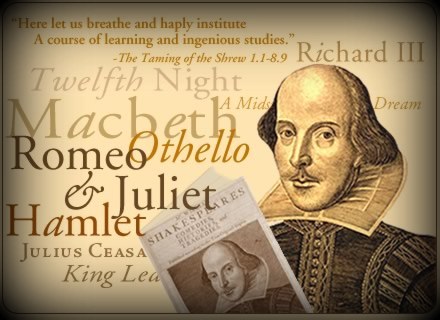
The Shakespeare Controversy

01v/11/arve/G2582/016Perhaps many of you will have heard that there is a sort of controversy over Shakespeare’s authorship of the plays. I shouldn’t really describe it as a controversy because it isn’t, or it shouldn’t be; a controversy exists when there is some doubt about one side of an argument, when there are two sides to an argument and no matter how tenuous one side is, there is some substance to it. Over eighty alternative authors have been put forward for alternative authorship; they have one thing in common: there is not a scrap of evidence for any of them.

This is a subject that, since I became aware of it, has made me quite angry. I have tried to ignore it, but it always creeps back; you see even the ‘Does it matter’ arguments are annoying. Of course it matters. I shall try, briefly, to explain.

Apparently, doubt as to the authorship of his works began in the mid-nineteenth century, well over 200 years after his death. Friends and colleagues of his time had no doubt about his identity; they worked and socialised with him; Ben Johnson said of him that he

‘never blotted a line, would that he had blotted a thousand’.

It seems to have taken rather a long time for people to question his identity. A paucity of evidence from his life has helped, giving doubters ammunition to invent and speculate, but despite the paucity there is ample evidence that he was the author of the works. It takes a rather strange mind to doubt it. Unfortunately, especially now, there are plenty of strange minds around. And, I repeat (it can’t be repeated too often), there is not a scrap of evidence for anyone else having written his works. None whatsoever.

This poses the question as to why there are doubters. If we discount those always keen on any conspiracy theories and those with a vested interests (often lawyers), we are left with a relatively small bunch who simply refuse to believe that Shakespeare wrote his own plays. This is important; it is not that they truly believe any alternative, although they profess to do so, it is that they merely refuse to believe the truth. There is a reason for this: it is called snobbery.

The most popular fantasy today is that the Earl of Oxford wrote the plays, supposedly because only an aristocrat could have known so much about court behaviour, Italian history and poetry. As Bill Bryson has observed, this does make it rather difficult for him to have written Othello, King Lear, Macbeth, Antony and Cleopatra, The Winter’s Tale, The Tempest and many others, on account of being dead. But his champions merely point out that there was a conspiracy and evidence was falsified to protect Oxford’s identity. Why it needed to be protected or why it has taken nearly 400 years to discover this, does not seem to concern them. The Oxfordians have some quite well-known followers, Jeremy Irons, Vanessa Redgrave, Derek Jacobi and Mark Rylance among them.

The fact that there is any controversy at all is extremely irritating, indeed US writer James Shapiro felt the need to write a recent book, Contested Will, to try and end the argument once and for all. It would have been much better had he used his time more productively – he is a marvellous writer on Shakespeare generally – but felt compelled to write on this topic when an 8 year old in his class expressed doubts as to the authorship (the debate, of course, is quite popular in America). I’m afraid that, having reached America and the lawyers and the film makers, even Shapiro’s excellent book will not make the doubters disappear. Although very much a minority, they are vociferous and probably growing. A film with Vanessa Redgrave and Derek Jacobi has already been made. Thankfully, it was awful.

But back to snobbery. Shakespeare has been described as looking like a ‘self-satisfied pork butcher’; he liked money; he hoarded grain; he lent money; he bought a coat of arms and a new house (called New Place) in Stratford. He was far from both the aristocracy and the poor, grammar school educated (a classical education) and with a father on the wrong side of the law. All this is too much for those who need him to be a bit more refined, a bit more superior, a bit more above everybody else. Pork butcher? Money lending? Hoarding grain? A criminal father? No, we can’t have that.

This is where the snobbery comes in. The likes of Irons, Jacobi and Redgrave need to have the author of such wonderful works as somebody a little better than them. Having never struggled to pay a bill, never struggled with anything really, they can’t accept that an ordinary boy from Stratford could be so much smarter than they are, be so wiser than they are – be so utterly brilliant. So they have to believe that it was really an aristocrat who wrote the plays; lacking any evidence for anybody, other than an aristocrat who happened to be dead when many of the plays were written, they cling desperately to an illusion. What awful, silly people they must be.

masks-001Shakespeare was so brilliant, so good, partly because he wasn’t a member of the aristocracy, wasn’t tainted by privilege and received ideas.  He hadn’t been brainwashed by a university education. He was real and he knew people. He lived among them in London, he visited pubs and brothels; he knew and understood life. He is one of us, one of the people – he is ours. That is what the likes of Jacobi cannot abide. They have to try and raise Shakespeare above us. They simply cannot stand the fact that he was an ordinary person and, more importantly, that ordinary people are capable of being Shakespeare – that there may be another Shakespeare out there among the masses. They would have to admit that it was possible, that there is more possibility among the masses than their privileged upbringing and lack of brainpower allows.

That is also why the question of authorship matters, that the greatest writer of all time was ordinary is very important. It should give inspiration to everybody. Allow these idiots to give the credit to an aristocrat and you rob the whole world of the possibility of great achievement. It matters.

I don’t have much space to go into the question of proof for Shakespeare’s authorship, I shouldn’t need to, but feel it necessary to mention a couple of things. The forest is a recurring theme in his plays. I quote from Peter Ackroyd’s biography:

“To the north of Stratford lay the Forest of Arden. When Touchstone enters the woods in As You Like It, he declares ‘I, now I am in Arden, the more foole I’. Shakespeare’s mother was Mary Arden.  Anne Hathaway lived on the outskirts of the forest.  His consciousness of the area was close and intense. The evidence of Shakespeare’s work provides evidence that he was neither born nor raised in the city. He doesn’t have the harshness of John Milton, born in Bread Street, nor the hardness of Ben Jonson, educated at Westminster School; the sharpness of Alexander Pope from the City or the obsessiveness of William Blake from Soho. He is of the country.”

On the question of snobbery I quote from an interview with Bill Bryson about his excellent short biography of Shakespeare:

Interviewer: Is it snobbery? He was a relatively ordinary man from a relatively ordinary background and they want him to be an aristocrat or somebody sort of special.

Bryson: That is really quite insulting to ordinary people. The idea that you could come from a modest background and that somehow that would disqualify you from being William Shakespeare is really a very demeaning thought. There’s no evidence for it. There never has been any evidence for it.

Oxfordians cannot explain Shakespeare’s knowledge of the country and its people. His knowledge of the cities came from living with them, his knowledge of Roman history from Plutarch. He was mainly an adaptor, he took other works and improved them. He wrote what are still some of the best parts for women, 400 years before feminism. He understood both men and women. He was modest; I’m sure he would be baffled by all the fuss about him today, although I’m sure he would take advantage of it.

Academics are generally very polite. In all the works stating (again) that the man from Stratford wrote the plays, they are very kind to the likes of Irons, Redgrave and Jacobi. They shouldn’t be; these people are a menace. They are snobs and idiots, too stupid to realise the damage they are causing. I suppose the best thing now would be to ignore them. I try to, but unfortunately they keep cropping up on television. It’s hard to see a solution.

To the Tower with them?

tol-001

No advertising today please…

penI had not realised until recently how much I dislike advertising. I have always been averse to it, but in my youth took very little notice of it and prided myself in believing that I was completely uninfluenced by it, that I had never bought anything because of an advert; most of it seemed completely idiotic to me; I found it hard to believe that anybody could be taken in by it. But it must work; otherwise we would not be so inundated with it.

Until a few years ago, I suppose I ignored it. I rarely watched commercial TV and somehow managed to avoid noticing the adverts when I did. Six years ago I bought a DVD which could edit recorded programmes, so now I very rarely have to put up with adverts – I simply pre-record, edit out the adverts and watch. On the occasions when there is something too good to miss though, I do sit through them. In 2011 Ofcom announced an increase from 7 minutes to 12 minutes of adverts allowed in an hour. Now, there was certainly more than 7 minutes before the increase and since the increase there is more than 12 minutes. Perhaps the seven minutes was manageable; it was possible to stay with a programme despite it; it was not too intrusive: two short breaks an hour or three very short breaks were just about acceptable.

Now the amount of advertising is definitely intrusive and there is much more than 12 minutes an hour. One example is the US import, Homeland. It is scheduled at one hour and five minutes, but my edited version (adverts removed) comes out at 41 or 42 minutes. Although the second and third series are pretty silly, it’s just about watchable. But it is impossible to watch live; the adverts are just too intrusive. After the lengthy introduction which is shown every week and the lengthy recap of what’s been happening, the first break comes after about 8 minutes, barely longer than the break which follows it. It is impossible to get involved in the storyline, the breaks come too often and are too long – all narrative flow is lost.

The extended breaks were originally proposed for a trial run. I doubt if there was any intention for this to be temporary; the breaks have continued and, without any announcement or permission, extended. It is claimed that broadcasters would invest more money in drama. That may be true, all commercial drama is now sponsored by somebody, but the dramas produced are just vehicles for advertising. I can’t think of one memorable drama that has come from ITV, despite an increase in production. Broadchurch was probably the best, but it was spoiled by being too long with a ridiculous and sentimental ending; it contained the same amount of adverts as the US imports with only 42 or 43 minutes of actual programming.

Broadcasters get around the new laws by starting programmes late and finishing early. They tag on adverts for their own programmes so that each break is 5, 6 or 7 minutes, fifteen to twenty minutes in total. I think the new laws have rendered commercial TV unwatchable. The fact that it is watched by millions says rather a lot about the people who watch it. How they allow themselves to be subjected to the advertising, I don’t know. Presumably a great many are influenced by it.

I remember twenty years ago that programmes had two breaks per hour. I can’t remember how long they were, perhaps three or four minutes. It was bearable. I also remember more adverts containing humour, so that even if you were not interested in the product, you could have a laugh about the ad. Adverts now seem consistently puerile, as if the advertising people are assuming that the audience are idiots. One has to assume by the size of the audiences that most of those watching probably are idiots. I find it amazing that people still complain about the BBC licence fee. Every argument against it has people moaning about having to pay it when they don’t watch it. Firstly, I don’t believe that they never watch it, and secondly, if you object to paying less that £3 a week for an advert free station, including radio, a world service, BBC 1, 2, 3 and 4 and the red button, you are probably mad.

I know it is another era and before the time of most of you, but one thinks back to 1981 when Granada serialised Evelyn Waugh’s Brideshead Revisited, with a magnificent cast. It was interrupted briefly twice. Practically the whole country stayed in to watch it, every week. It is unthinkable now that any commercial station would attempt such a thing. The nearest we have had is the recent run of Shakespeare’s Richard II, Henry IV parts 1 & 2 and Henry V on the BBC. They were appreciated and discussed online, but I suspect it was a very small audience.

Advertising for the new products (phones, laptops, iPads, flat screen TVs) seems to concentrate on their coolness, with dozens of happy but vacant teenagers desperate to replace what they bought six months ago. The ads are beautifully put together but absolutely empty. The same goes for cosmetics and car ads: empty cool; either that or half-wits being persuaded to bet or enjoying their TVs exploding or shooting at them. One after another they are stultifying. I dread to think of the American mind, where they have been subjected to this for much longer with less choice. Last year it was said that the average American was exposed to 3000 adverts per day. I think it is impossible to say; it depends on the individual, but for the incautious viewer or internet user, it is certainly a lot. This country is not far behind.

I would like to think that I have been subjected to no advertising today. Nothing when I get up because I don’t watch anything until I get to work. Since then I have glanced at Facebook but did not look at the ads down the side; I have bought some food but I’m pretty sure that I did not look at any of the many Greggs ads plastered all around the restaurant; I did not register whatever ads my email providers tried to tempt me with; when I get home I may watch some TV but it is very doubtful that it will be a commercial station, if it is I will probably record it and edit the adverts out; I will be subjected to the BBC advertising its own programmes (far too much); their many links are unnecessary and must be exorbitantly expensive. But that’s about it. My dislike of advertising is such that when I do watch something like Homeland, I have to turn the sound down and even turn away or leave the room during the breaks – I can’t even stand to see the images. They are horrible: disgusting, sentimental, unrealistic, very clever garbage. I have become immune and allergic to advertising.

I am off to Cuba this Christmas. Whatever else you might say about Cuba, they do not allow advertising – five channels with no adverts – ever. How long they can hold out I don’t know, but more power to them. And thank God, thank Buddha, thank everyone for DVD players that can edit. I may have to buy a few of them for the future. I’m sure the Americans will ban them some day.

Writing Heroes – William Shakespeare

“It is not in the stars to hold our destiny but in ourselves.”

My first experience of Shakespeare was a performance of The Tempest on a school trip; I hated it. Three years later I was given a copy of Macbeth as one of my ‘O’ Level books: I loved it. I read it and studied it and wrote about it. I achieved a good grade. After that, until I reached middle-age, I had very little to do with Shakespeare; I don’t enjoy the theatre much and found his plays difficult to follow. I went to see Roman Polanski’s Macbeth at the cinema in the 70s and loved that (it is still the best version), but It was only when I began helping students with their English that I started to appreciate him, and, only then, through the filmed versions.

Since then, having studied him on and off for a few years, I have discovered that I like Romeo and Juliet, Othello, The Merchant of Venice, A Midsummer Night’s Dream, As You Like It and A Winter’s Tale; I love Macbeth but baulk at the walking wood. I don’t like Hamlet or King Lear. I do like Julius Caesar, Troilus and Cressida, Measure for Measure and Coriolanus, all rarely performed, although Coriolanus does seem to be having a revival, partly due to its supposed similarities with today’s society.

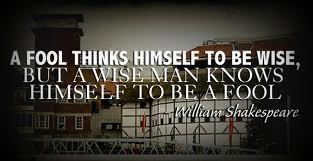
wsquote-001All of the Henry plays are good but particularly Henry VIII, one of the least performed. I like Richard II and love Richard III, even though it is a complete fiction (Tudor propaganda); I like Much Ado About Nothing but don’t yet understand The Tempest; Anthony and Cleopatra is marvellous; I enjoyed bits of Cymbeline, but the version I watched had a young Helen Mirren dressed as a boy (impossible to believe). I don’t like Pericles or The Taming of the Shrew. I am indifferent to Love’s Labour’s Lost, Twelfth Night and All’s Well that Ends Well. I know nothing about the Two Gentlemen of Verona, A Comedy of Errors, The Merry Wives of Windsor or King John.

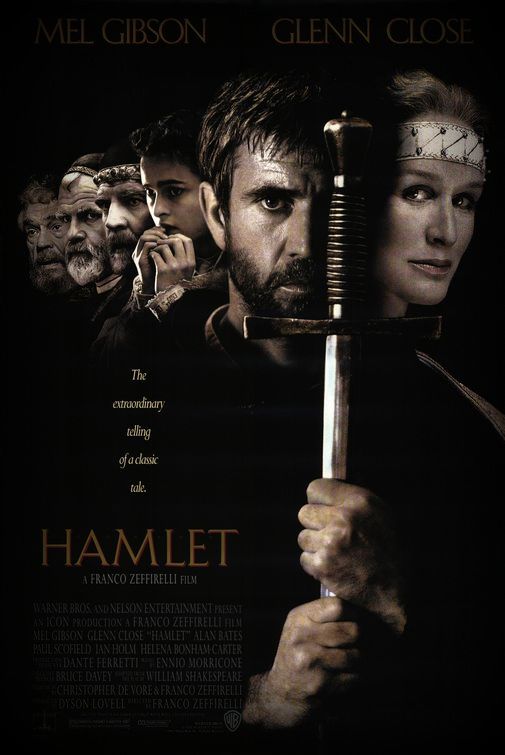
I think that just about covers them all; forgive me if I have forgotten anything. I enjoy watching Hamlet even though I don’t like him. Such a fuss is made about his tortuous journey and his suffering and tragic death, but I just find him a terrible whinger and get fed up with him very quickly. He is responsible for the deaths of Polonius (harmless old fool), Rosencrantz and Guildenstern (to be fair they would have had him killed otherwise, but only because of his awful behaviour), his mother and Ophelia, the one true innocent in the play. I found Ophelia the only sane person in the play and she is destroyed by Hamlet. Kenneth Branagh’s four hour film is quite entertaining but the best I’ve seen so far is Zeffirelli’s version with Mel Gibson.

hamlet-001King Lear and Hamlet are two of the most popular plays today. It is easy to obtain copies of performances and there are many films of both; I have seen quite a lot of them (the best King Lear is a Russian version by Grigori Kozintsev). As I said, I enjoy watching performances of Hamlet but have no sympathy at all with the play’s theme, which to me is: spoilt, self obsessed brat prattling on endlessly about his problems and dealing with them far too late, thereby causing the deaths of many. I suppose I get fed up with critics taking Hamlet (the character) so seriously (I grant his language is wonderful) when I find him very unlikeable.

King Lear is a play often performed and analysed. I hope I’m wrong, and one day might be convinced otherwise, but I find the whole thing ridiculous. I know it is about a foolish old man mistaking flattery for love and not recognising true love, of not understanding that the giving away of territory would change everything – of not understanding anything until it is too late; but it is told in such convoluted fashion, with too many characters and too many ridiculous scenes. I cannot watch the scene on the beach near the end without laughing.

I find Macbeth one of the most watchable of plays, partly because it is so short (the shortest). Its theme is simple: overarching ambition and female manipulation. There are one or two parts where I have to suspend disbelief: the walking wood, Lady Macbeth collapses into madness too quickly, but it is a marvellously entertaining example of what Shakespeare was best at: taking basic human emotions and dramatising them; of course all drama should do this but only Shakespeare did it so well.

One thing that stands out in all the plays though, is the language; there is wonderful language in all the plays. I’ll make a ridiculous understatement and say that Shakespeare had a way with words. Like no other before him or since, he could encapsulate the most profound thoughts and feelings in what is, when studied, beautifully simple language. His best plays are a joy throughout – I can watch them once or twice a year. The recent BBC series of Richard II, Henry IV parts 1 & 2 and Henry V was superb.

The way I found access to Shakespeare was through film. Watching his plays in the theatre I find that, unless one knows the play by heart (difficult), the language is lost – while thinking about one line, it is quickly followed by another and another and so much is lost, simply because it is impossible to keep up. With film, and today almost everything has subtitles, it is possible to pause and think, to absorb and understand and thereby find a way in to the plays.

This has been only a brief and haphazard introduction into my thoughts on Shakespeare. I have already written a rather self-indulgent review of Throne of Blood, Kurosawa’s film version of Macbeth. But bear with me. I would like occasionally to share my thoughts on Shakespeare, particularly the ridiculous authorship controversy, in the future. How do other writers feel about this – any other Shakespeare lovers out there? Or am I merely wallowing in my own enjoyment of him?

wsmontage-001

Throne of Blood

Macbeth was the first Shakespeare play I encountered. It captured my imagination more than any other, partly perhaps because it is more concise: it tells a simple tale and wastes no time. I remember at age sixteen that I thought Lady Macbeth was the main influence of the tale, that Macbeth, left to his own devices, would have done nothing.

sword-001

Recently, I watched Throne of Blood, which is Akira Kurosawa’s (1957) filmic take on Macbeth. Though dated in some ways, I found it fascinating, and I thought he placed much more emphasis on the Lady Macbeth figure, Asaji. Because Japanese society was so hierarchical and constricted, particularly for women, it allowed Kurosawa to demonstrate Lady Macbeth’s (Asaji’s) influence. Although women were restricted in Macbeth’s time, it was even more so for Japanese women. Kurosawa created a film that showed subtly and cleverly, how a woman can manipulate a man. Washizu (Macbeth) is not very bright, but he has all the power. Asaji must be very careful how she manipulates him. In this sense I think Kurosawa was limited by the constraints of following the play. Asaji’s collapse is too quick, too brief – she was stronger than that (as was lady Macbeth in the original play).

But enough preamble; this is a bit self-indulgent (and long), but I hope you will bear with me. Without having seen the film, this will mean nothing to you, so all I can do is recommend it very highly. Perhaps if any of you watch it, you can then come back and agree or disagree with me.

 ***

 The film begins…

throneblood-001Throne of Blood – The Review

Santeria – part three


I don’t really understand santeria. I have experienced it possibly four times; I go with the flow and do what I’m told but I don’t understand. I have discovered though, that very few people do. Joel James Figarola asks:

‘Is there in Cuban culture, specifically in popular tradition, any sort of practice which, consciously or not, is meant to diminish the fear of death? If it were so, does such practice imply that sort of feeble religiosity or limited capacity for abstract thinking which some authors have attributed to the Cuban individual?’

I think I know what he means by ‘the limited capacity for abstract thinking’; the Cubans that I know live very much in the present moment; history, which is yesterday, or one hour ago, is just forgotten, and one moves on with whomever happens to be around at that time. The only permanence seems to be family, perhaps some friends, but friends are quickly forgotten when they disappear (which is very common here), but they are remembered if and when they reappear. Figarola continues:

‘…that thick syncretic interweave which the ordinary Cuban individual is. The magical-religious systems created among us, are an attempt to achieve conciliation and serenity, to subdue chaos by integrating death as a domestic, everyday presence.’

Figarola believes that aspects of santeria

‘…are most probably acting as channels between transcendental aboriginal conceptions and those derived in the past century, from African populations brought into the Island as slave force, or from Antillean immigrant labourers…both black and white, in various ways and from different places, bring to the Island a traumatic experience interwoven with broken memories, projects and nostalgia: a broken inner world to be inserted in a new world in a perennial state of rupture.’

‘Transcendental aboriginal conceptions’ – I have often wondered about this. The native Indian population was quickly wiped out by the Spanish. Apparently the Indians were incredibly innocent, naive (and small); they did not know how to fight and apparently were extinguished quickly and completely. I would like to discover more about them but that will have to wait for another time. Were they all wiped out; every single one of them? I suppose if some survived, there is very little or no influence from them now. Then came the slaves, from all parts of Africa, and with them came their beliefs and stories and rituals. Cuba has also (apart from the last fifty years) been in a constant state of revolution:

‘…in a perennial state of rupture’;

this, in very simple terms, must be the basis for santeria – Where are we from? What are our stories? Who are we?

redcar-001

Santeria makes Cubans unique:

‘… a spiritual environment where life is lived as if one would die the following day – which is to say as if one would never die -, where the dead are not expelled from the everyday world of the living nor ostracised from the family.’

Most black people here are descended from slaves and many, many in-betweens too.

‘Slavery is collective death. The newly arrived African slave loses his own environment, his emotional references, his memory; on the other hand, the criollo slave, born without an environment of his own, surrounded by emotional references inimical to him, inherits no memory at all.’

‘…the barracks, the whip, and the stocks, in the sense of cultural projection; and the wealth resulting from such efforts is contained in the foundations of each one of our major magical-religious systems.’

‘A certain detachment prevails in the social mind, disrupting the citizen’s accommodation in the general body and generating a diffuse yet exact there is no place for me sort of feeling.’

‘In the last fifty years the Island has been immersed in the urgent task of drawing new circumstantial limits; hence, death has recovered the sympathetic and fertile connotations it possessed when the nation was born in la manigua (the wilderness). Death in revolutionary Cuba is not an act of solitude but a unanimous communion of hopes; and in face of the usual enemies and occasional hardships, the words of the Gospel come to us: “O Death, where is thy sting? O Grave, where is thy victory?”’

‘Even if much has been written on the subject, I do not think that we Cubans have yet been able to fully comprehend the extent to which slavery and the plantation system conditioned social behaviour and values, either in material or spiritual matters, either in immediate or prospective terms.’

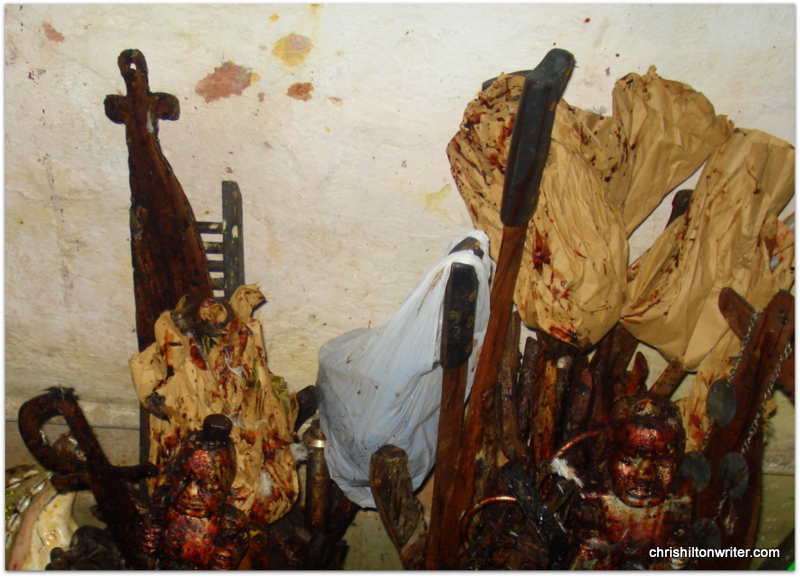
I was quite relieved to read the above. My first experience of santeria, several years ago, involved, basically: ‘nobody really understands it’. I believe that is still the case. Santeria involves countless rituals. They are not made up; every one is recorded from previous experience, written down and referred to. Also involved is percussion, lots of it and for very long periods, chanting, singing and dancing. It always involves at least two people and the subject (usually many more than two, sometimes as many as will fit into a space). I will explain no more.

For what it is worth, I believe that santeria is a response to chaos, the chaos of many centuries of Cuban life, followed by the revolution, hope, brief comparative prosperity, hardship again and now perhaps hope – although none of that is acknowledged – Cubans live for the moment, don’t worry about much else and express themselves through santeria.

DSC00553

Cuban magical religious systems cannot be analysed as independent structures; not one of them, despite their isolation or liturgical complexity, exists without a functional reference to the others.

Rómulo Lachañtarés believes that santeria is a system of local cults. In relation to santeria there are five fundamental reglas (cults). If we were to go any deeper inside any of them, we would run, like it or not, into the others. Each system, thus, inhabits its own recognisable space, while it steps into the territories of the others.

The orisha cult or Regla de Ocha is expressed in a total subduing of the dead in favour of the orishas (Yoruban deities).

Other systems include Oggunismo, Espirito de Cordón, Regla Muetera and Regla de Palo Monte. We are concerned here only with Regla de Ocha or santeria: Yoruban origin.

1 – Ridden by orishas: The repertory of gestures is quite conventional. Theatricality and stereotypes are the obvious frame for a wavering personality.

2 – Ridden by anonymous or unknown muertos:  Possession is weak and superficial. There is no prearranges code for gesture except for closed eyes. No sounds are produced and no attempt is made to establish communication.

3 – Ridden by orishas as mortal spirits: Strong, violent states offering no possible communication. The orisha rides following the mortal, earthly avatar he enjoyed before death and ulterior deification. Possession acquires a tragic mood, as if the orisha was intuitively and wildly searching for whatever has been lost. This is specially so in the case of warrior gods.

None of the above sufficiently explains any of my experiences. This was just the best, short explanation I could find. Joel James Figarola believes that:

‘trance or possession is a quality, talent or capability of human psychic nature, regulated by cultural determinations which are closer to ethnic – not to mistake for racial – heritage rather than to immediate social or educational circumstances. Trance and possession are thus part of the reservoir of human potentialities, and much as, for example, feelings and emotions, they are tones of the mnemonic range of the species. Mystic crises of communication involving forces believed to be transcendental are part of the foundations of every religion and are easily traceable throughout the planet. Both the Old and the New Testament, to name but two instances, contain clear references to this matter.’

Although he believes that ‘fraudulent imitation is far from rare’, he finds that the most convincing example of possession is the third in santeria: orishas in their avatar as dead individuals:

‘in santeria they attempt to achieve a fair enough communion with the orishas’.

I found the examples of possession fairly convincing.

DSC00554Santeria – part one

Santeria – part two

Santeria – part two

In Yuri’s eight day absence, her mother will come to the flat and cook for me. Tomorrow I go the santeria myself. At the flat I make do against the heat (33˚), which is not too bad; there is a mostly constant breeze and it rains on many days, mostly the evening. I can look after myself but Yuri has taken care of everything; my Spanish is awful, I can’t protest, so I’m happy to let things be as they are. I am considered useless and happy to be so.


Tomorrow at ten in the morning Yuri’s mother and sister will call for me.


They came at ten on the dot and we walked the half-mile or so to the place of santeria. Yuri had been there for two days. Her head had been shaved and she wore a white dress. The room was full of every type of paraphernalia to do with santeria: fruit, herbs, crusts of bread, myriad objects, tassels and objects of clothing. She sat in one corner of the room on a mat, above her a triangular canopy of yellow. We were soon joined by about eight other people, some to do with Yuri, others about their own business. For an hour they just talked and laughed. Three of the women were the same as we had seen the week before, but in a different place. This was the real thing.

DSC00553

After about an hour and a half I was taken aside. My hair was washed with something strange, doused with coconut juice and dried slightly, while the woman chanted in Yoruba. Then I was taken to a separate room where desiccated coconut was placed on my feet, knees hands, chest, neck and finally the top of my head, all the while as chanting took place. Then the largest pile of coconut (on my head) was covered with a cap, and left.


The santeria man has a nice house, a very wide screen TV and several women working for him. He’s very sociable and everybody likes him.


I went to see Yuri on Sunday, still dressed in white although there are yellow dresses she changes into at other times. She is tired. She sits on a mat in the corner of the room. She must sleep there too. I drank a coffee and talked for a while, but soon exhausted my limited Spanish and what I had been doing (very little) and left after about an hour. I hated the time Yuri was away. Although my Spanish is extremely limited and her English almost non-existent, we seem to communicate well. Much of the time she isn’t here, but I know she will be back and that makes all the difference. The eight days she was away, apart from writing and the occasional film, I did not know what to do. I have been to Havana so many times that walking held little attraction, and it is over 30˚. A woman comes to clean every few days, Yuri’s mother and sister come to cook, but I find I’m rarely hungry. I go and collect cash when I need it. I went to watch the beginning of the English football season on Sunday, but it appears that ESPN have lost the English games to BT, so I just waited until I knew the score and left.


After eight days, Yuri returned. Her head has been shaved. She wears a quite substantial pair of drawers, tights, socks, a white dress and a white head dress. She must wear this stuff every time she goes out, and she must go out and walk around every day. She must not have the sun on her, so she carries a white umbrella. In the house she can wear a white shift and remove the tights but everything else remains. She must eat while sitting on a mat and somebody else must wash her empty plate. She must wear this stuff and behave like this for three months, all the time remaining in Havana. After three months she can return to Bahia Honda, but must continue to wear the outfit for a year.

133

I had noticed people wearing all white, but it was not until Yuri had her treatment that I realised why. Walking around Havana, one day you might see two or three people all in white, their hair at various stages of growth; on another day you might see ten or more. This is not scientific, but of the people I saw, perhaps 30% or 40% were white. Whatever Yuri had done, it is very popular (for those who can afford it). I have been to perhaps four places that practice santeria. There are many, many other places and hundreds of shops supplying trinkets and many secret places providing animals for sacrifice. I would imagine that Cubans do get conned, but not often; tourists are fair game and I would expect the gullible to be fleeced. This eight day treatment is the first time I’ve spent any substantial amount on santeria – and it does involve a lot of expense.


The first Friday after Yuri had completed she returned for a final ritual on her Padrino’s birthday. Free food, loads of it was available for everybody. Some people were drinking, but not many. Yuri’s ritual lasted an hour or two, involved lots of percussion and people dancing and chanting around her. Two or three others had similar rituals; one black man seemed to be possessed and was taken into another room, where he continued to speak in a voice of possession for a couple of hours. The Padrino listened to every word. If there is anything suspect about santeria, it is still very, very hard work.


I’m not disillusioned with santeria; I’m just a bit bored with it all. Not understanding the language doesn’t help. But this is something that means a great deal to Yuri and I’m happy to provide it. In future though, I won’t have much to do with it. It can be fun, it can be a spectacle – but I’ve just about seen enough….


The third and final installment of my Santeria experience will be posted on Monday.

 Santeria – part one